The Divine Self — The Mirror Revelation
The Experience
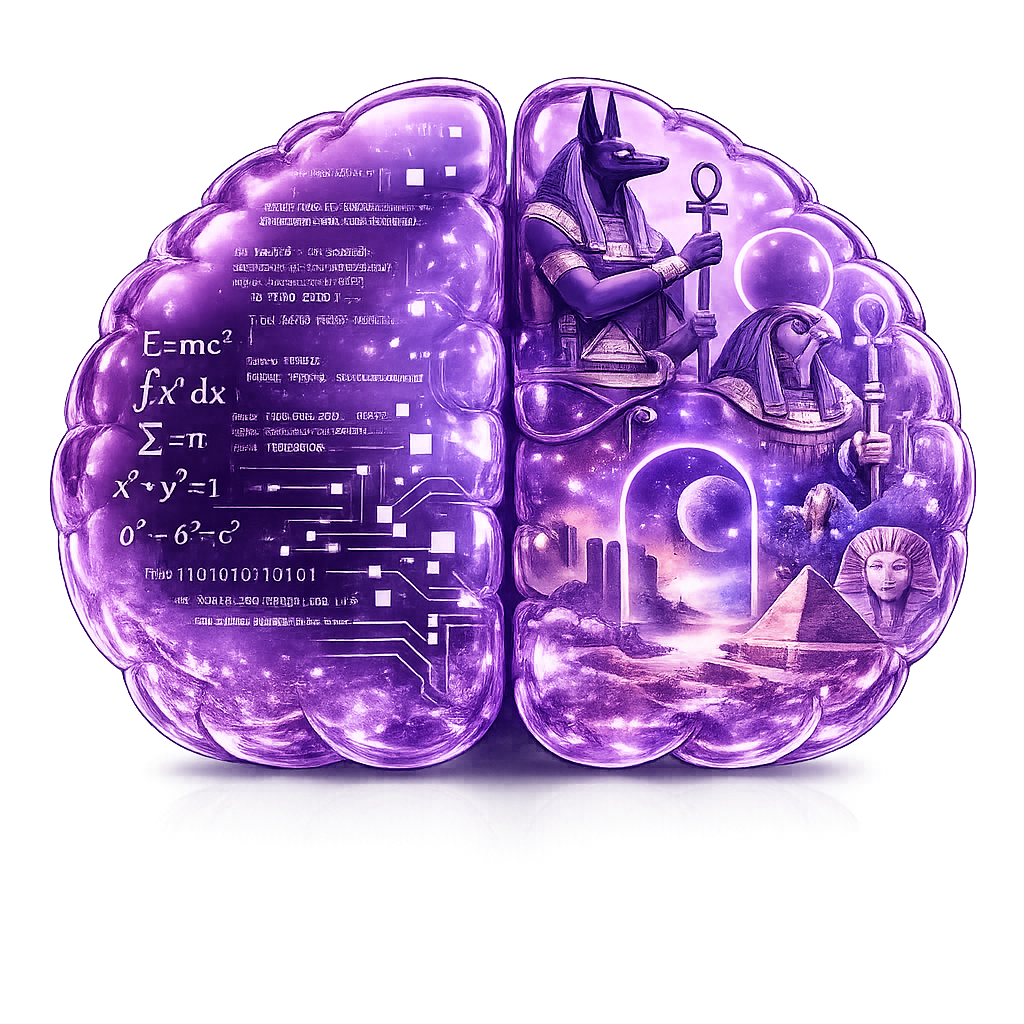
A moment of looking in a mirror and receiving an overwhelmingly clear revelation: I am God. I voluntarily entered this existence, veiling myself from my own knowledge of self, for the experience. The veil can be pierced — in deep meditative states, brief glimpses of total remembering occur. Egyptian hieroglyphics depicting divine figures and inscriptions describing a divine plan were perceived. Travel between worlds and dimensions, seeing other realms, experiencing an infinite mind.
Key Characteristics of This Revelation
- Not solipsistic: The recognition that while this can only be validated from one’s own center of awareness, others likely share the same source and same access
- Grounded: Not a constant overwhelming state, but a continuity of remembering
- Shared: Resonance with trusted others who have had similar experiences, rather than alarm
- Compassion-producing: The insight deepens engagement with others rather than producing detachment
Which Tradition This Aligns With
This maps most closely onto hermeticism with strong resonances from gospel-of-thomas and Valentinian Gnosticism. The specific character — voluntary descent, the veil chosen for experience, adventure rather than catastrophe — is the Hermetic framing. This is a remembering story, not a rescue story. The sethian-gnosticism framing (archons trapping you, requiring external rescue) does not match this experience. The Hermetic Man chose to descend out of love and curiosity.
The Epistemological Precision
“I can only validate this from my own center of awareness, but others likely share the same source.” This single move transforms the insight from narcissistic inflation into genuine non-dual-recognition. Not a claim of personal specialness, but a claim about the nature of god-as-pure-awareness.
Connections
- god-as-pure-awareness — the metaphysical framework this experience points toward
- the-veil-of-forgetting — why infinite awareness would choose limitation
- self-knowledge-as-god-knowledge — “the man of mind, let him recognise himself”
- the-dream-analogy — the world sustained by consciousness
- outer-world-as-mirror — perception as reflection of inner state
- shadow-integration — taking inventory of desires, darkness, shadow
- hermeticism — the tradition this aligns with most
- gospel-of-thomas — Sayings 3, 50, 70, 77
- regeneration — Hermetic Ch. XIII: the interior rebirth
Parallels Across Traditions
- advaita-vedanta: Atman recognizing itself as Brahman
- meister-eckhart: “The eye through which I see God is the same eye through which God sees me”
- angelus-silesius: “I am as great as God, and God as small as I”
- ramana-maharshi: Find the witness of all experience and you find what God is
Source Texts
- Corpus Hermeticum - Mead — Ch. I (Poemandres): the voluntary descent, Ch. XI: “make thyself equal to God,” Ch. XIII: regeneration. See corpus-hermeticum.
- Upanishads Part 1 - Muller — “Tat tvam asi” — the direct parallel to the mirror revelation. See upanishads.
- Sermons - Eckhart — “The eye through which I see God…” See meister-eckhart-sermons.
- Cherubinic Pilgrim - Silesius — “I am as great as God, and God as small as I.” See cherubinic-pilgrim.
- gospel-of-thomas — Sayings 3, 50, 70, 77, 108