Angelus Silesius
The Figure
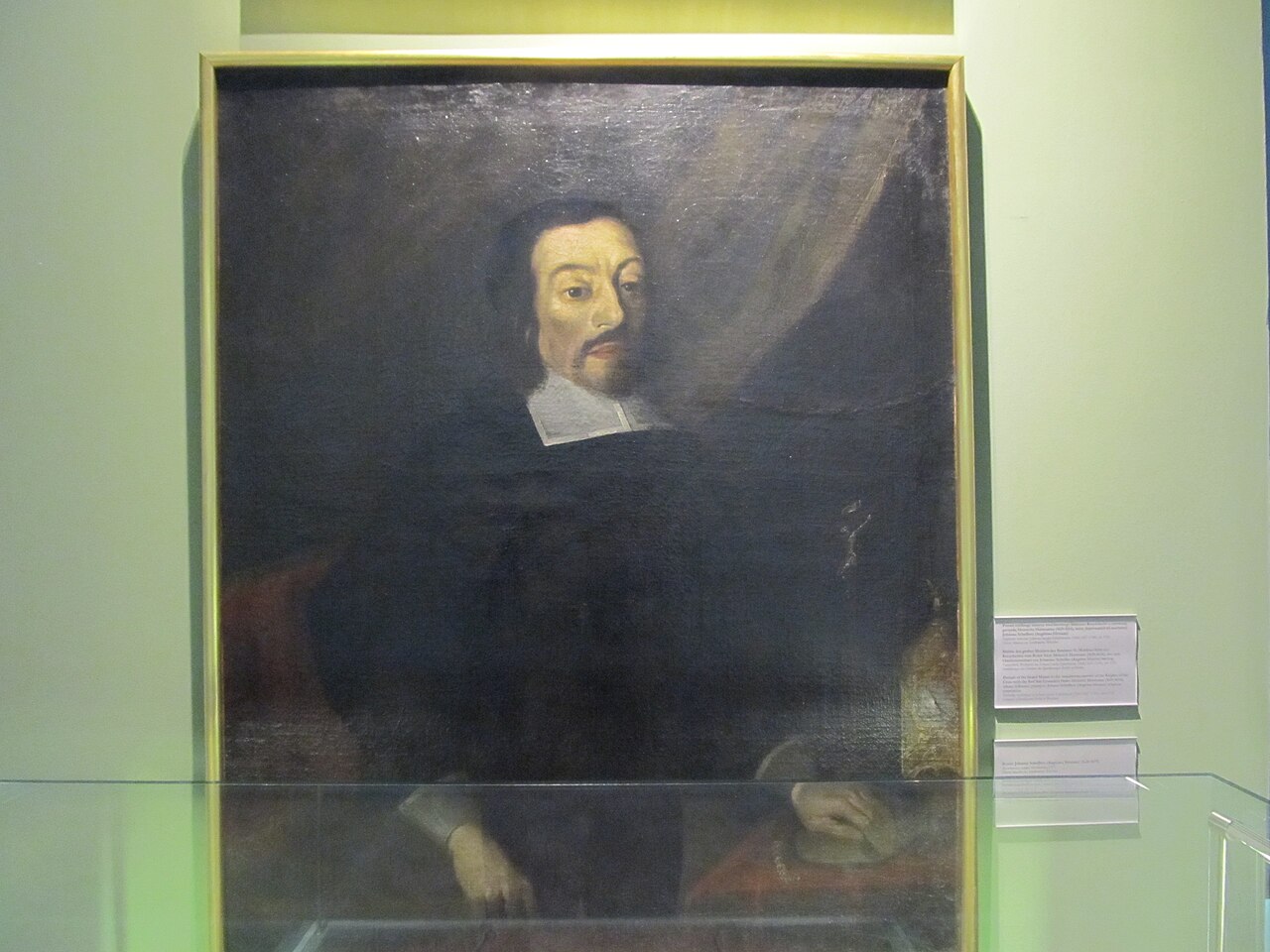
Johann Scheffler, known by his pen name Angelus Silesius (“Silesian Messenger of God”) — a German mystic, poet, and physician. Born in Breslau (now Wroclaw, Poland) to a Lutheran family, he converted to Catholicism in 1653 and was ordained a priest in 1661. His major work, The Cherubinic Wanderer (Cherubinischer Wandersmann, 1657), is a collection of over 1,600 rhyming couplets expressing the most radical non-dual theology in the Christian tradition.
Where meister-eckhart delivered his insights in dense theological prose and vernacular sermons, Angelus Silesius distilled the same vision into crystalline epigrams of devastating brevity. Each couplet is a small detonation.
Key Verses
“I am as great as God, and God as small as I; He cannot be above, nor I below Him lie.”
This is not blasphemy but the logical conclusion of self-knowledge-as-god-knowledge — if the ground of the soul and the ground of God are one (as Eckhart taught), then there can be no ontological hierarchy between them.
“The rose is without why; it blooms because it blooms. It cares not for itself, asks not if it is seen.”
Existence needs no external justification. Being is its own reason. This anticipates Heidegger’s meditation on Gelassenheit by three centuries.
“God is a pure No-thing, concealed in now and here; the less you reach for Him, the more He will appear.”
The apophatic theology of neoplatonism rendered in two lines. God cannot be grasped as an object — only encountered when grasping ceases.
“In God nothing is known: He is One and alone. What is known is in Him: He is not His own.”
“You must be the thing itself: if not, God will not serve. The eye must be the sun, or it will not see the sun.”
The knower must become what is known. See: non-dual-recognition, god-as-pure-awareness.
The Tradition He Inherits
Angelus Silesius stands in a direct line of German-language mysticism:
- meister-eckhart (c. 1260-1328) — the theological foundation
- Johannes Tauler (c. 1300-1361) — Eckhart’s student, more pastoral
- Jakob Bohme (1575-1624) — the “Teutonic philosopher,” theosophist
- Angelus Silesius (1624-1677) — the poetic crystallization
This lineage constitutes the strongest non-dual current within Western Christianity, running parallel to but independent of advaita-vedanta and hermeticism.
Why He Matters for This Exploration
The couplet quoted in the-divine-self — “I am as great as God, and God as small as I” — captures in fourteen words what the mirror revelation disclosed experientially. The value of Silesius is precision: he says in two lines what takes a treatise to unpack. Each verse is a seed that unfolds into an entire contemplative practice.
Connections
- meister-eckhart — his primary theological source
- the-divine-self — the personal revelation this poetry validates
- god-as-pure-awareness — God as the seeing, not the seen
- self-knowledge-as-god-knowledge — the eye must become the sun
- non-dual-recognition — the dissolution of the God/soul boundary
- neoplatonism — the apophatic theology underlying his vision
- hermeticism — parallel non-dual tradition from a different lineage
- logos — the Word born eternally in the soul