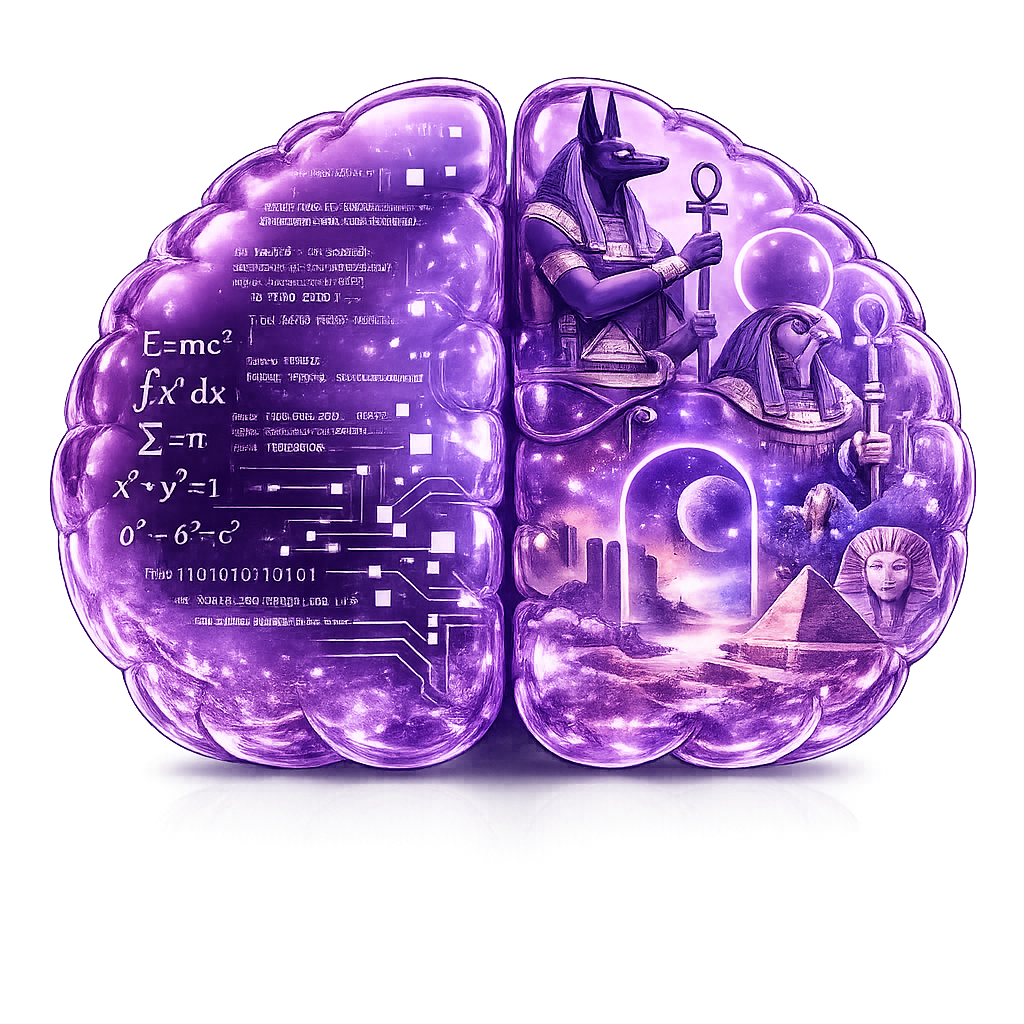
Self-Knowledge as God-Knowledge
The Central Command
“The man of mind, let him recognise himself.” — Poemandres, Ch. I Self-knowledge in the Hermetic sense is not psychological introspection but ontological recognition: the realization that one’s deepest self is not the body, the emotions, or even ordinary thoughts, but Mind itself — of the same substance as the divine.
The Radical Claim
When you truly know yourself at the deepest level, you find not a private individual but the universal. The boundary between the human mind and the divine Mind dissolves in genuine self-knowledge. “Light and Life are The God and the Father, from Whom the Man was generated.”
Gospel of Thomas — Saying 3
“The kingdom is inside you and it is outside you. When you know yourselves, then you will be known, and you will understand that you are children of the living father. But if you do not know yourselves, then you dwell in poverty and you are poverty.” Self-knowledge is not optional — without it, you are the poverty, the ignorance, the forgetting.
Gospel of Thomas — Saying 70
“If you bring forth what is within you, what you have will save you. If you have nothing within you, what you do not have within you will kill you.” The divine spark either becomes conscious and liberates, or remains unconscious and destroys.
Connections
- god-as-pure-awareness — what is found at the bottom of self-knowledge
- the-divine-self — the personal experience of this recognition
- ignorance-as-root-evil — not knowing the self is the root of suffering
- shadow-integration — knowing the shadow is part of self-knowledge
- outer-world-as-mirror — external perception as map of internal state
- hermeticism — “the man of mind, let him recognise himself”
- gospel-of-thomas — Sayings 3, 70, 108
- regeneration — the culmination of self-knowledge in rebirth
Source Texts
- Corpus Hermeticum - Mead — Ch. I: “The man of mind, let him recognise himself.” Ch. XI: “If thou dost not make thyself like unto God, thou canst not know Him.” See corpus-hermeticum.
- Upanishads Part 1 - Muller — “Tat tvam asi” (Thou art That) — self-knowledge as Brahman-knowledge. See upanishads.
- Sermons - Eckhart — “The ground of the soul and the ground of God are one ground.” See meister-eckhart-sermons.
- gospel-of-thomas — Saying 3: “When you know yourselves, then you will be known”
- Bhagavad Gita - Arnold — “I am the Self seated in the hearts of all beings” (Ch. 10). See bhagavad-gita.