Hermes Trismegistus
The Figure

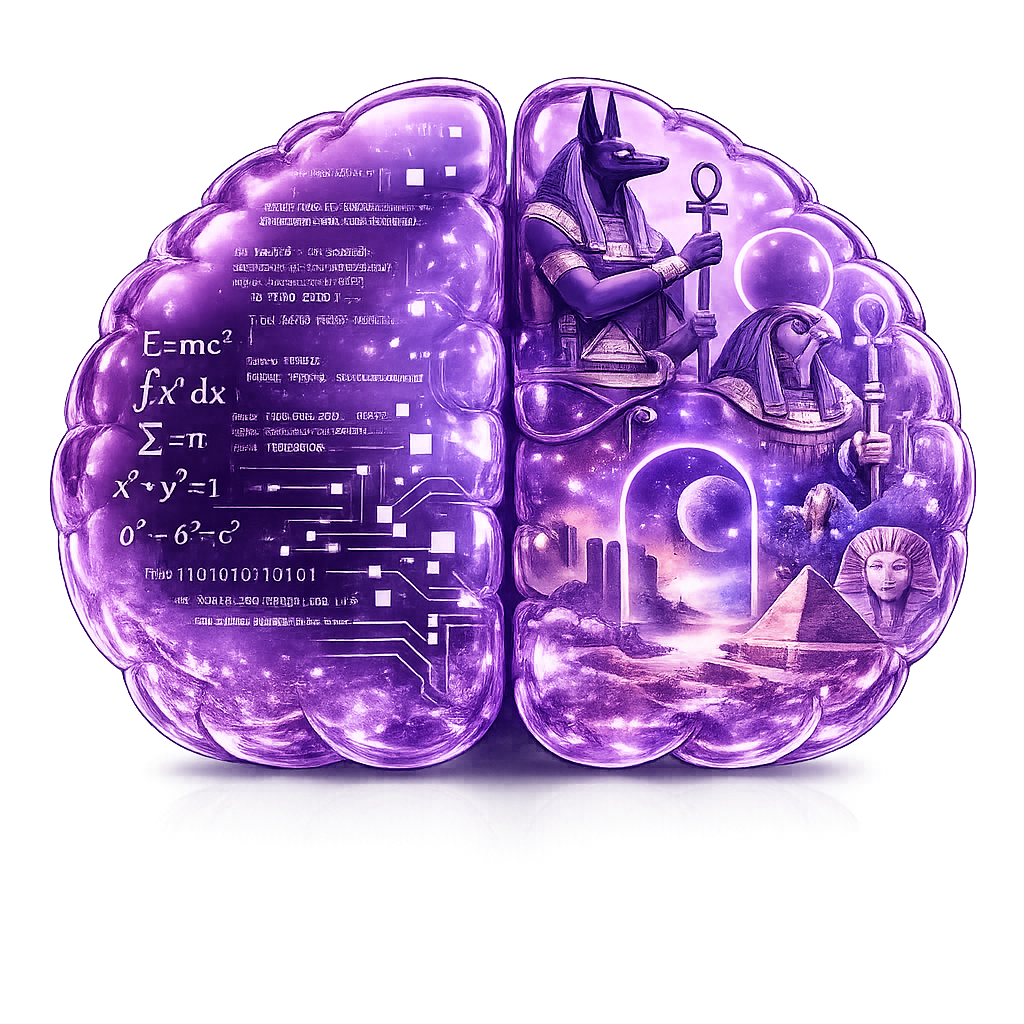
“Thrice-Greatest Hermes” — a syncretic fusion of the Greek god Hermes (messenger, guide of souls, patron of wisdom) and the Egyptian god Thoth (scribe of the gods, inventor of writing, keeper of divine knowledge). Not a historical person but a wisdom figure — the mythical author to whom the entire hermeticism tradition attributes its revelations.
The epithet “Trismegistus” (thrice-greatest) appears in Egyptian temple inscriptions honoring Thoth as “great, great, great” — supreme among the gods in wisdom. Greek-speaking Egyptians in Ptolemaic and Roman Alexandria adopted this figure as the mouthpiece for a sophisticated philosophical theology that synthesized Egyptian priestly wisdom, Greek philosophy, and Jewish cosmogony.
Role in the Texts
In the corpus-hermeticum, Hermes appears in two roles:
- As student: In the Poemandres (Ch. I), Hermes receives a cosmic vision from the divine Mind itself — the origin of all things, the fall of Man into matter, and the path of return. He is the archetype of the initiated soul.
- As teacher: In the remaining treatises, Hermes instructs his disciples — his son Tat and the figure Asclepius — in the nature of God, Mind, the cosmos, and the soul’s ascent. The discourse on regeneration (Ch. XIII) is delivered by Hermes to Tat on a mountain, in silence.
The Egyptian Connection
The identification with Thoth is not merely decorative. Thoth was:
- The divine scribe who recorded the weighing of souls in the Hall of Ma’at
- The inventor of hieroglyphics — sacred writing as divine technology
- The keeper of the Emerald Tablet tradition: “As above, so below”
- Associated with the moon, measurement, and the mediation between opposites
The Hermetic texts may preserve fragments of genuine Egyptian temple philosophy, filtered through Greek philosophical categories. The question of how much is authentically Egyptian versus Hellenistic construction remains open. See: the-divine-self for the personal experience of Egyptian hieroglyphic visions during revelation.
Historical Impact
- Renaissance: Marsilio Ficino translated the Corpus Hermeticum in 1463 (before translating Plato), believing Hermes was a historical figure contemporary with Moses. This triggered the Hermetic revival that shaped Renaissance magic, art, and philosophy.
- Isaac Casaubon (1614) demonstrated the texts were post-Christian in composition, but this did not diminish their philosophical depth.
- The figure influenced alchemy, Rosicrucianism, Freemasonry, and the Western esoteric tradition broadly.
Key Teachings Attributed to Hermes
- god-as-pure-awareness — God is Mind, the substance of all things (Ch. XI)
- self-knowledge-as-god-knowledge — “The man of mind, let him recognise himself” (Ch. I)
- ignorance-as-root-evil — “The greatest evil among men is ignorance of God” (Ch. VII)
- regeneration — interior rebirth through expelling vices and receiving divine powers (Ch. XIII)
- The soul’s ascent through seven planetary spheres after death
- God is “invoked by silence” — contemplative inwardness as primary method
Connections
- hermeticism — the tradition attributed to this figure
- corpus-hermeticum — the collected writings
- gnosticism — the sibling tradition emerging from the same milieu
- neoplatonism — the philosophical framework Hermeticism draws from
- thoth — the Egyptian divine identity
- alchemy — the tradition Hermeticism fed into
- plotinus — contemporary Neoplatonist whose thought parallels the Hermetic
- nous — the divine Mind that Hermes receives revelation from
- logos — the creative Word described in the Poemandres cosmogony