Emerald Tablet
Overview
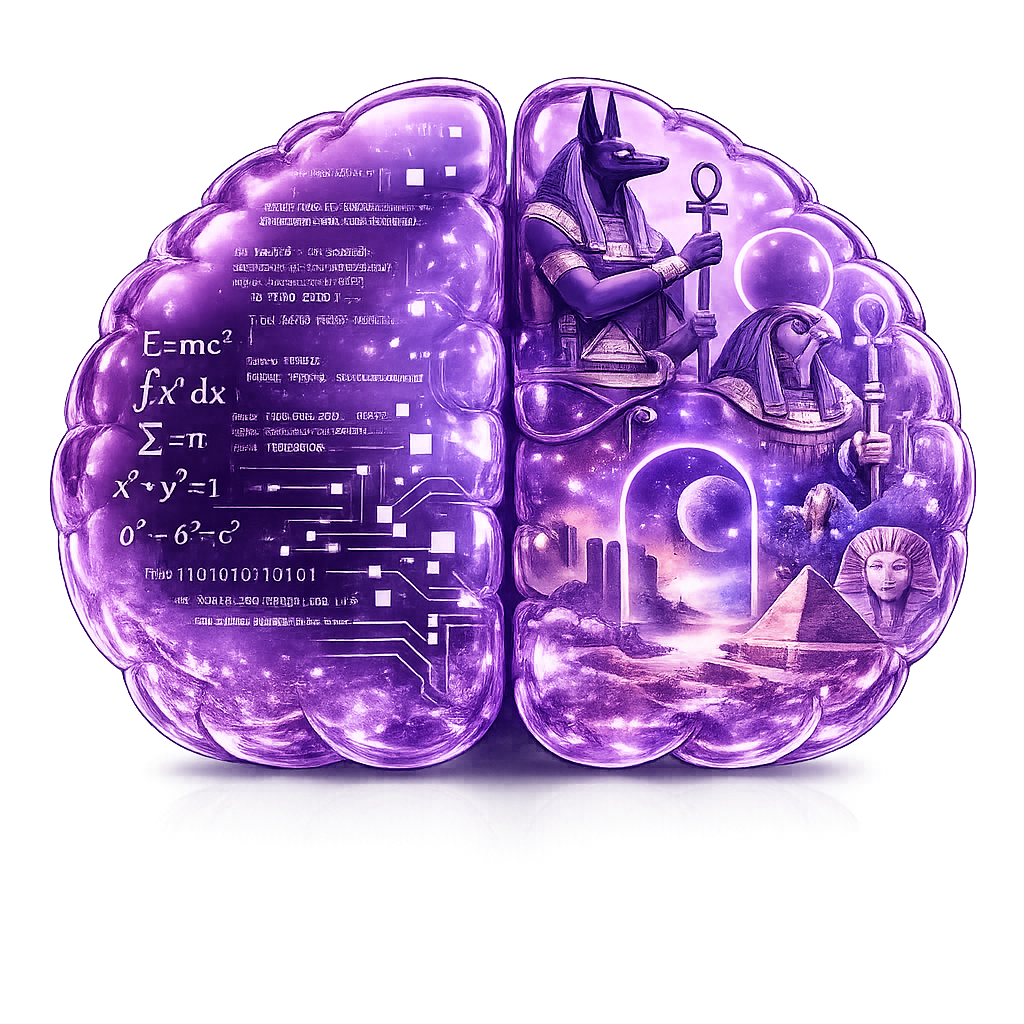
The Tabula Smaragdina is the single most famous text in the Western alchemical and Hermetic tradition — a short, cryptic declaration of cosmological and operative principles compressed into roughly a dozen sentences. Its opening axiom, “That which is above is like that which is below, and that which is below is like that which is above, to accomplish the miracles of the One Thing,” became the cornerstone formula of Hermetic thought: the doctrine of correspondence between macrocosm and microcosm, heaven and earth, spirit and matter.
Despite its brevity, the Tablet functions as both a philosophical manifesto and an alchemical recipe. It describes the generation of all things from a single source through the agency of the Sun (active, masculine) and Moon (receptive, feminine), carried by wind and nourished by earth. It names the Telesma — the one force, the “strength of all strengths” — that penetrates every subtle thing and orders the structure of the world. Alchemists read it as instructions for the Great Work; philosophers read it as a map of emanation and return; mystics read it as a description of interior transformation.
The Tablet’s influence is almost impossible to overstate. It shaped the language and conceptual framework of alchemy from the medieval Arabic jabir tradition through the Latin West, into Renaissance Hermeticism, and onward into modern esotericism. Newton translated it. The Rosicrucians enshrined it. It remains the single text most people encounter first when approaching the Hermetic tradition, and its central axiom — “as above, so below” — has passed into common parlance far beyond its original context.
Key Themes
- The doctrine of correspondence: macrocosm mirrors microcosm, and vice versa
- Unity of all things — generation from a single source (the “One Thing”)
- The Telesma: universal creative force that penetrates all levels of being
- Solar and lunar principles as complementary agents of creation
- alchemy as both physical operation and spiritual discipline
- The “father” and “mother” of all perfection — active and receptive cosmic principles
- Separation and recombination as the method of transmutation
Historical Context
The earliest known version of the Emerald Tablet appears in Arabic, within the pseudo-Aristotelian Kitab Sirr al-Asrar (Book of the Secret of Secrets) and in works attributed to Jabir ibn Hayyan, dating to roughly the 6th-8th century CE. The Arabic tradition claimed it was found inscribed on an emerald slab in the tomb of Hermes — hence the name. It was translated into Latin in the 12th century, most influentially by Hugo of Santalla, and rapidly became the foundational proof-text of Latin alchemy.
There is no Greek original. The Tablet is not part of the corpus-hermeticum and has a separate, almost certainly Arabic-era origin, though its ideas resonate deeply with the Hellenistic Hermetic worldview. Scholars debate whether it preserves genuinely older Egyptian or Hellenistic material in Arabic dress or is a medieval composition drawing on earlier Hermetic motifs. Multiple translations exist — the most commonly cited English versions are those by Isaac Newton (c. 1680, found among his alchemical papers), Madame Blavatsky, and various modern translators. Each translation subtly shifts the emphasis, making the Tablet a kind of Rorschach test for its interpreters.
Who Should Read This
Anyone beginning the study of hermeticism or alchemy — this is the single shortest text that encapsulates the entire tradition’s core logic, and engaging with its compressed language is a rite of passage.
Connections
- hermeticism — the philosophical tradition the Tablet epitomizes
- hermes-trismegistus — the attributed author and legendary sage
- alchemy — the operative tradition built on the Tablet’s principles
- neoplatonism — the emanationist metaphysics underlying “as above, so below”
Further Reading
- Emerald Tablet of Hermes — Complete text with multiple translations