Unus Mundus — The One World
The Concept
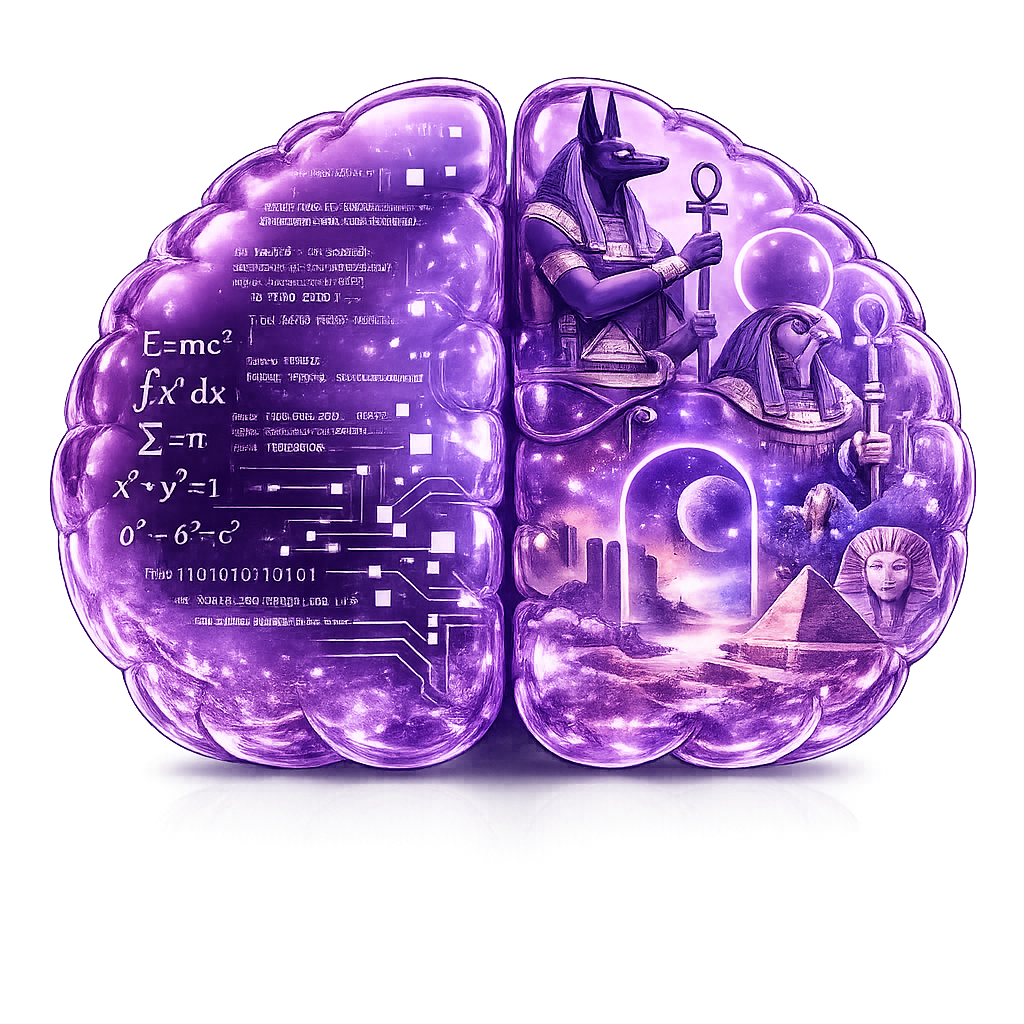
Unus Mundus (Latin: “one world”) — the unified reality underlying the apparent duality of psyche and matter. Not a metaphor. Not a philosophical aspiration. A structural claim about the nature of reality: that at some fundamental level, the distinction between inner experience and outer event has not yet arisen.
The term originates in medieval alchemy and scholastic philosophy, but it was Carl Jung who revived it as the theoretical foundation for synchronicity. If meaningful coincidences connect inner states to outer events without causal mechanism, then there must be a domain in which “inner” and “outer” are not yet separate. That domain is the Unus Mundus.
Jung and Pauli
Jung developed the concept in collaboration with Wolfgang Pauli, the Nobel laureate physicist. Their exchange — documented in The Interpretation of Nature and the Psyche (1955) — represents one of the most remarkable intellectual partnerships of the twentieth century: a depth psychologist and a quantum physicist converging on the same insight from opposite directions.
Pauli brought the observer problem in quantum mechanics: the act of measurement collapses the wave function, meaning consciousness is not separate from the physical system it observes. Jung brought the empirical evidence of synchronicity: psychic states correlating with physical events in ways that defy causal explanation.
Their shared conclusion: the psychophysical split is not fundamental. It is an artifact of a particular level of observation. Beneath it lies the Unus Mundus — a unified field that is neither purely mental nor purely physical, but the common root of both.
The Alchemical Origin
The alchemists intuited this long before quantum mechanics. Their Great Work was never merely chemical — it was the transmutation of the operator as much as the substance. The lapis philosophorum (philosopher’s stone) was simultaneously a physical substance and a state of consciousness. This was not confusion or pre-scientific thinking. It was an expression of the Unus Mundus: in the unified reality, the distinction between the stone and the sage who creates it does not hold.
Jung recognized the alchemical tradition as the historical carrier of this insight: “The alchemists… were in fact searching for something that could not be found in the retort… the lapis is at the same time a stone and not a stone.”
Unus Mundus and Synchronicity
Synchronicity is the empirical evidence for the Unus Mundus. When a patient dreams of a golden scarab and a golden scarab beetle strikes the window, the connection is not causal — no chain of physical events links the dream to the beetle’s flight path. Yet the connection is real, meaningful, and transformative.
The Unus Mundus explains how this is possible: dream and beetle arise from the same unified field. At the level of the Unus Mundus, they are not two events that coincidentally match — they are one event, perceived as two only because we observe from within the psychophysical split.
Parallels Across Traditions
The insight is not unique to Jung:
- Hermeticism — “As above, so below; as within, so without” (Emerald Tablet). The correspondence between macrocosm and microcosm presupposes a unified ground
- Advaita Vedanta — Brahman is the single reality of which both mind and world are appearances (Advaita Vedanta)
- Neoplatonism — Nous contains all forms; the material world is its self-expression, not its opposite (Enneads)
- Buddhism — the Heart Sutra’s “form is emptiness, emptiness is form” dissolves the matter/mind boundary
Connections
- synchronicity — the empirical manifestation of the Unus Mundus
- collective-unconscious — the psychic dimension of the unified field
- carl-jung — who revived and developed the concept
- nous — the Neoplatonic parallel: divine Mind as the ground of all
- maya — the Vedantic perspective on the appearance of multiplicity
- gnosis — direct experiential knowledge of the unified reality
- non-dual-recognition — the epistemological framework
Key Texts
- Jung, C.G. (1955–56). Mysterium Coniunctionis (CW 14), esp. Ch. 14: “The Conjunction”
- Jung, C.G. & Pauli, W. (1955). The Interpretation of Nature and the Psyche
- Meier, C.A., ed. (2001). Atom and Archetype: The Pauli/Jung Letters, 1932–1958
- von Franz, M.-L. (1974). Number and Time: Reflections Leading Toward a Unification of Depth Psychology and Physics