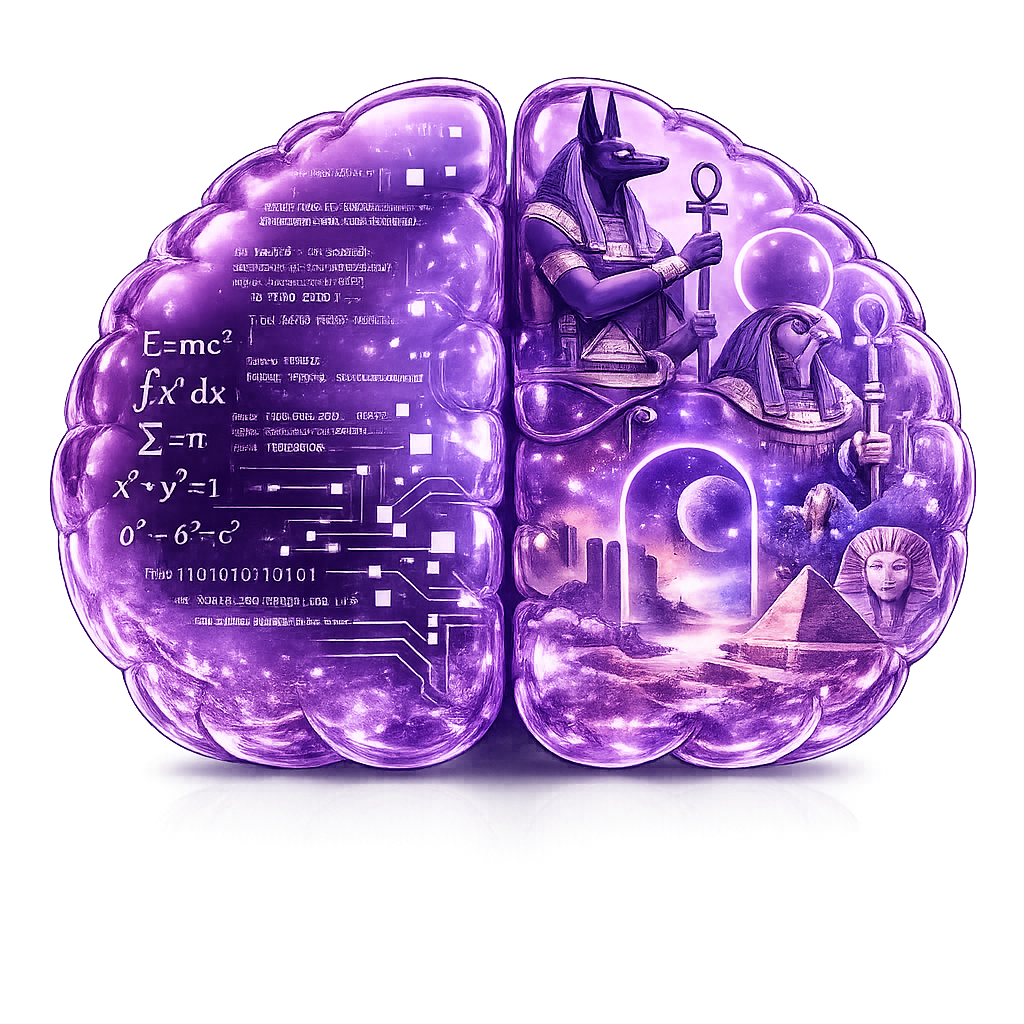
Wisdom of the Egyptians
Overview
The Wisdom of the Egyptians is Brian Brown’s compilation covering the major currents of Egyptian religious and philosophical thought: the Book of the Dead, the figure of Hermes Trismegistus, Egyptian magical practices, and the legendary Book of Thoth. Rather than a specialist’s deep dive into any single text, it functions as a survey that traces the connections between ancient Egyptian religion and the Hermetic tradition, making explicit the lineage that runs from the temples of Thebes and Memphis to the philosophical schools of Hellenistic Alexandria.
The book’s particular value lies in its bridging function. It presents Egyptian religion not as a dead artifact but as a living tradition that transformed and continued. The funerary rites of the Book of the Dead, the magical practices of the temple priests, the cult of Thoth as lord of wisdom and sacred writing — all of these flow forward into the Hermetic corpus, which Brown treats as a genuine (if Hellenized) continuation of Egyptian sacred knowledge. The Book of Thoth, whether understood as a legendary text of total knowledge or as a metaphor for the initiatory wisdom preserved in temple traditions, represents the link between priestly Egypt and philosophical Hermeticism.
For the reader approaching Egyptian thought for the first time, this compilation offers a useful map of the territory. For the student of Hermeticism, it provides the Egyptian context that the Hermetic texts themselves often assume but rarely explain. The claim that Hermeticism is essentially Egyptian wisdom in Greek philosophical language — a claim made by the Hermetic texts themselves and debated by scholars ever since — finds its most accessible presentation here.
Key Themes
- Continuity from Egypt to Hermeticism — The central argument is that Hermetic thought is a genuine continuation of Egyptian religious wisdom, not merely a Greek borrowing of Egyptian imagery
- The Book of Thoth — The legendary text of total divine knowledge, whether literal or metaphorical, as the bridge between priestly initiation and Hermetic philosophy
- Hermes Trismegistus as Thoth — The identification of the Hermetic sage with the Egyptian god of wisdom, writing, and sacred knowledge
- Egyptian afterlife traditions — The soul’s journey through the Duat as both funerary practice and initiatory template
- Magic as sacred technology — Egyptian magical practice as the practical application of theological principles, not mere superstition
- The unity of Egyptian sacred knowledge — Religion, magic, philosophy, and science as aspects of a single integrated worldview
Historical Context
Brown’s compilation was published in 1923, during a period of intense public interest in Egyptology (the discovery of Tutankhamun’s tomb was in 1922). It draws on the major English translations available at the time, particularly Budge’s work on the Book of the Dead and Egyptian magic. While subsequent scholarship has refined many of the specific claims, the book’s central thesis — that there is genuine continuity between Egyptian religious thought and the Hermetic tradition — has been increasingly supported by modern research into Greco-Egyptian religion and the cultural milieu of Hellenistic Alexandria.
Who Should Read This
Readers seeking an accessible introduction to the relationship between Egyptian religion and Hermeticism. Useful as a starting point before engaging with the primary Hermetic texts, providing the Egyptian background that illuminates their imagery and concerns.
Connections
- hermeticism — The book’s central subject is the transmission of Egyptian sacred knowledge into the Hermetic tradition
- hermes-trismegistus — Traces the identification of Hermes Trismegistus with Thoth and the implications of that identification for understanding Hermetic authority
Further Reading
Full text: Wisdom of the Egyptians - Brown