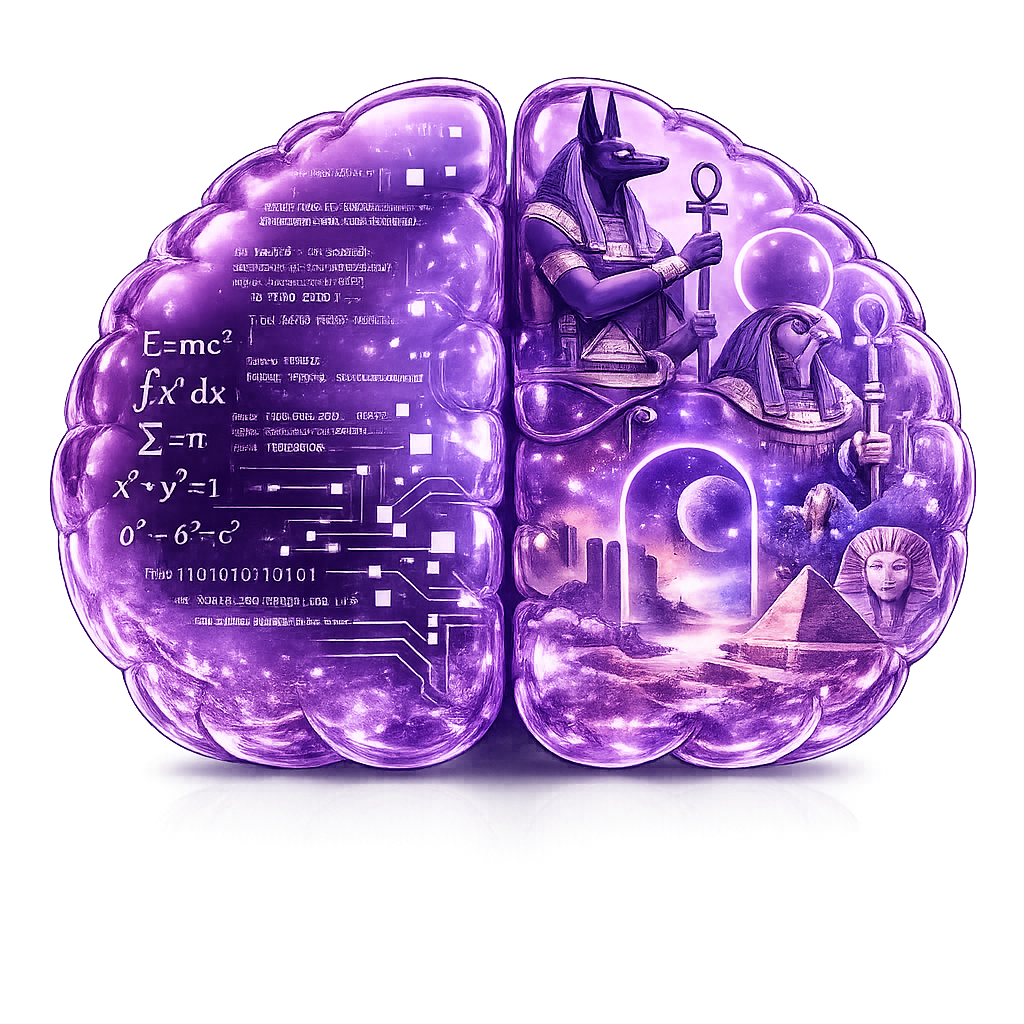
Thoth — Egyptian God of Wisdom
Thoth (Djehuty in Egyptian) is the ibis-headed god of writing, magic, wisdom, measurement, and the moon. In Egyptian cosmology he is the scribe of the gods, the inventor of hieroglyphs (medu neter, “the words of the god”), the reckoner of time, and the keeper of the divine records. He stands at the scales of Ma’at in the Hall of Judgment, recording the result as the heart of the deceased is weighed against the feather of truth. He is also the guide of the dead through the Duat (the underworld), the one who knows the spells, the secret names, and the hidden paths. In the Book of the Dead, his presence at the judgment scene is not ornamental — without Thoth, the soul cannot navigate the afterlife. He is wisdom made operational: not abstract contemplation but knowledge that functions, that opens doors, that transforms.
Thoth’s significance extends far beyond Egyptian religion through the process of syncretism that occurred in Ptolemaic Alexandria (3rd century BCE onward). When Greek culture encountered Egyptian culture, Thoth was identified with Hermes — the Greek god of communication, boundaries, and the psychopomp who guides souls to the underworld. From this fusion emerged Hermes Trismegistus (“Thrice-Great Hermes”), the legendary sage to whom the entire Hermetic corpus is attributed. Hermes Trismegistus is neither fully Thoth nor fully Hermes but a new figure: the master of all wisdom — spiritual, philosophical, and magical — who embodies the synthesis of Egyptian priestly knowledge with Greek philosophical inquiry. The Corpus Hermeticum, the Asclepius, and the vast body of technical Hermetica (on alchemy, astrology, and magic) all trace their authority back to this figure.
To understand Thoth is to understand the root of the Hermetic tradition. The Egyptian emphasis on sacred writing, on the magical power of words and names, on the scribe as the preserver and transmitter of divine knowledge — all of this flows into Hermeticism’s conviction that wisdom is not merely intellectual but transformative, that to know the truth is to be changed by it. Thoth is not a philosopher in the Greek sense; he is a magician-priest-sage whose knowledge is inseparable from power. This fusion of knowing and doing, of gnosis and praxis, is the distinctive character of the Hermetic path that his syncretized form, Hermes Trismegistus, would carry into the Western esoteric tradition for two millennia.
Key Themes
- Sacred writing — the inventor of hieroglyphs and the divine power of language
- Psychopomp — the guide of souls through death and the underworld
- Divine record-keeper — the scribe who records truth at the scales of judgment
- Wisdom as power — knowledge that transforms, not merely informs
- Syncretism — the fusion with Greek Hermes that produced Hermes Trismegistus
- The lunar god — associated with the moon, cycles, measurement, and hidden knowledge
Connections
- hermes-trismegistus — the syncretic figure born from the fusion of Thoth and Hermes
- hermeticism — the tradition that traces its lineage to Thoth through Hermes Trismegistus
- book-of-the-dead — Thoth’s role in guiding the soul through the afterlife
- egyptian-magic — the magical dimension of Thoth’s wisdom
- legends-of-the-gods — Egyptian mythological context for Thoth’s role among the gods
- nous — Thoth as the embodiment of divine intellect in Egyptian form
Further Reading
- E.A. Wallis Budge, The Gods of the Egyptians, Vol. 1 — comprehensive account of Thoth
- Richard Jasnow and Karl-Theodor Zauzich, The Ancient Egyptian Book of Thoth
- Garth Fowden, The Egyptian Hermes — the definitive study of Thoth-to-Hermes Trismegistus
- Erik Hornung, The Secret Lore of Egypt — Egyptian wisdom traditions and their later reception