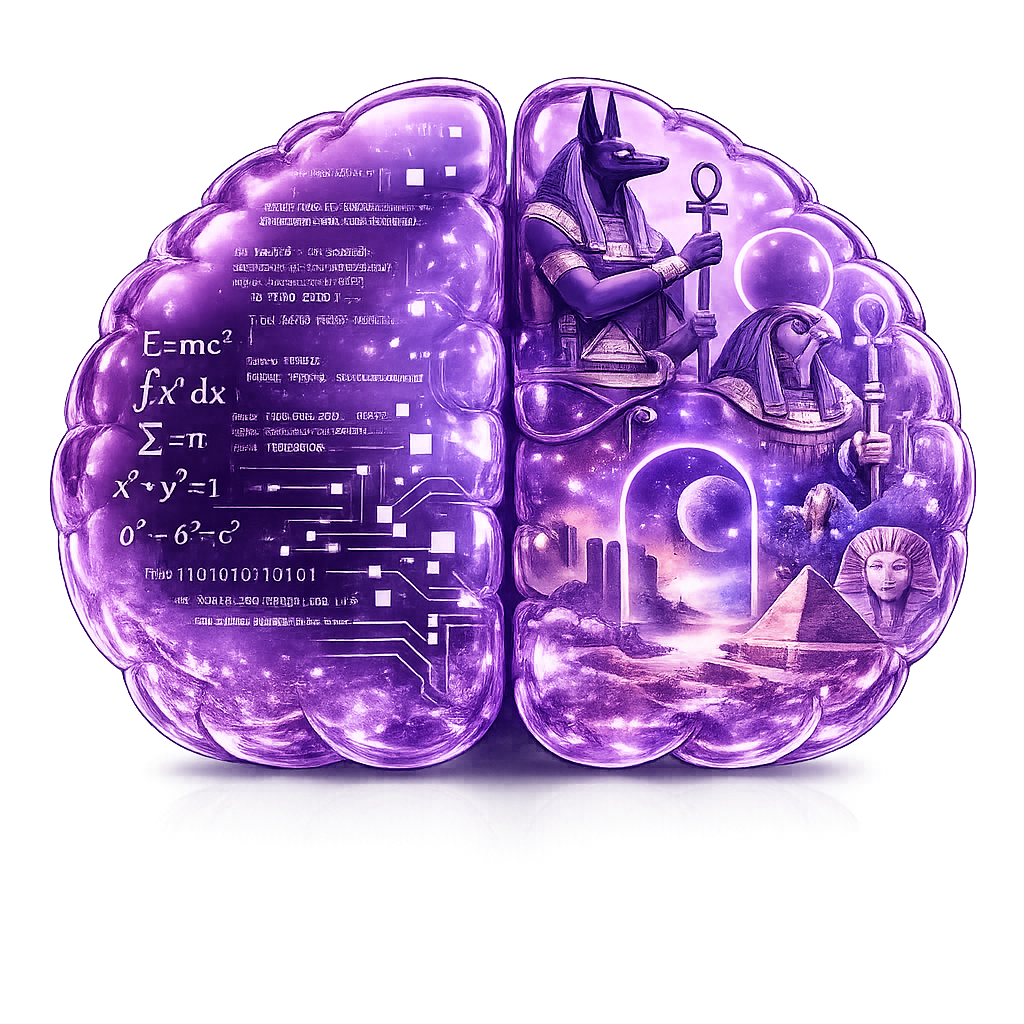
Virgin of the World
Overview
The Kore Kosmou (“Maiden of the World” or “Virgin of the World”) is a Hermetic dialogue in which Isis instructs her son Horus in the secret teachings she received from Hermes Trismegistus. Preserved in the Anthologium of John of Stobaeus (5th century CE), it stands apart from the corpus-hermeticum proper — it is not among the seventeen treatises collected under that name — and reveals a layer of Hermetic thought that is more openly Egyptian, more mythological, and more concerned with the descent and imprisonment of souls in bodies than the philosophical treatises of the main corpus.
The dialogue’s cosmogony is striking. It describes God creating souls from a special mixture of cosmic elements, assigning them to the stars, and then — when they grow restless and transgress — casting them down into human bodies as punishment and education. The earth becomes a prison and a school. Isis recounts how the souls wept at their incarnation, how the gods took pity and sent arts, sciences, laws, and mysteries to console them, and how the path of return was established through initiation and purification. The feminine divine is central: Isis is not merely a narrator but the supreme initiator, the keeper of the mysteries, and the one who reveals the architecture of the soul’s journey.
Anna Kingsford and Edward Maitland’s 1885 translation — published as The Virgin of the World of Hermes Mercurius Trismegistus — brings a Victorian esoteric sensibility to this material. Kingsford, a physician, anti-vivisectionist, and Christian mystic who presided over the London Lodge of the Theosophical Society, was drawn to the text’s emphasis on the feminine dimension of divine wisdom. Her translation, based on Louis Menard’s French edition, reads as much as an interpretation as a rendering — but it captures the mythic grandeur of the original and remains the most accessible English version of this important but often overlooked Hermetic text.
Key Themes
- The feminine face of Hermetic wisdom: Isis as supreme initiator and transmitter of secret knowledge
- The fall of souls: creation in light, transgression, and incarnation in bodies as both punishment and school
- divine-spark — souls as fragments of celestial substance imprisoned in matter, longing for return
- The gift of the arts and sciences as divine consolation for incarnate souls
- Cosmic hierarchy: God, the gods, the souls, the elements — each with its proper station and duty
- sophia — Isis as a figure of divine Wisdom, linking Hermetic and Gnostic feminine theology
- Initiation and purification as the path of the soul’s liberation
- The Egyptian mythological substrate of Hermeticism — more visible here than in the philosophical treatises
Historical Context
The Kore Kosmou survives only in Stobaeus’s anthology, where it appears alongside other Hermetic excerpts that did not enter the main Corpus Hermeticum collection. Its date of composition is uncertain but likely falls within the same 1st-3rd century CE range as the core Hermetic treatises. What makes it distinctive is its thoroughgoing use of Egyptian divine names and mythological framing — Isis, Horus, Osiris, Hermes-Thoth — rather than the more Hellenized, philosophically abstract language of treatises like the Poemandres. Some scholars argue it represents an older or more “Egyptian” strand of Hermetic thought; others see it as a parallel development within the same Greco-Egyptian milieu.
Kingsford and Maitland’s 1885 translation appeared during a period of intense British interest in esoteric religion. Kingsford was a remarkable figure — one of the first English women to earn a medical degree (from Paris, since English universities barred women), and a visionary mystic whose The Perfect Way (1882) proposed an esoteric Christianity centered on the divine feminine. Her engagement with the Kore Kosmou was part of a larger project to recover the feminine dimension of Western spirituality. Mead later retranslated the text in his Thrice-Greatest Hermes Vol III with more philological rigor, but Kingsford’s version retains a literary and spiritual quality that continues to attract readers.
Who Should Read This
Readers interested in the mythological and Egyptian dimensions of hermeticism that the more philosophical Corpus Hermeticum tends to obscure, and anyone drawn to the figure of Isis as a divine teacher and the feminine face of esoteric wisdom.
Connections
- hermeticism — the tradition this text belongs to, in its more mythological register
- hermes-trismegistus — the original source of the teachings Isis transmits
- sophia — the divine feminine as keeper and transmitter of sacred knowledge
- divine-spark — the soul as celestial substance trapped in matter, seeking return
Further Reading
- Virgin of the World - Kingsford — Complete text of the 1885 Kingsford & Maitland translation