Plotinus
The Figure
The founder of neoplatonism and arguably the most influential philosopher between Aristotle and Aquinas. Born in Lycopolis, Egypt. Studied philosophy in Alexandria under the enigmatic Ammonius Saccas (who also taught the Christian theologian Origen). Traveled with a military expedition to Persia seeking Eastern wisdom. Settled in Rome around 244 CE and taught there until his death.
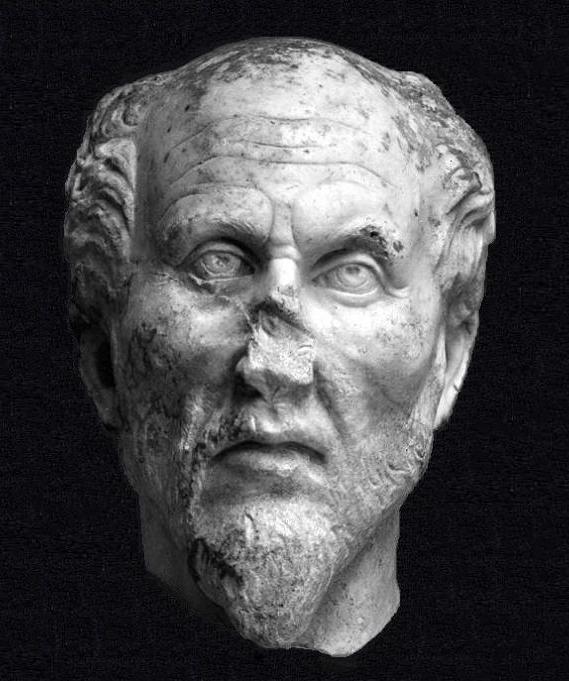
His student Porphyry collected and organized his writings into six groups of nine treatises each — the Enneads (“Nines”). His last words, according to Porphyry: “I am striving to give back the divine in myself to the divine in the All.”
The Three Hypostases
Plotinus’s great contribution is a three-tiered metaphysics of emanation:
The One (To Hen)
The absolute first principle — beyond being, beyond thought, beyond description. Not a thing among things but the source from which all things flow. “It is none of the things of which it is the source.” The One does not think, because thinking requires a subject-object division the One transcends. It is pure unity, pure potentiality, pure overflowing generosity.
The One is not diminished by emanation, just as the sun is not diminished by its light, or a spring by its water. This is the key metaphysical move that separates Neoplatonism from Gnosticism: creation is not a fall or a catastrophe but a natural overflow of superabundant goodness. See: hermeticism-vs-gnosticism.
Nous (Divine Mind / Intellect)
The first emanation — nous. Mind contemplating the One, generating the Forms (Platonic Ideas) as it does so. Nous is where thought, being, and beauty first emerge. It is the realm of the pleroma in Gnostic terms, though Plotinus would reject the Gnostic narrative that overlays it.
Soul (Psyche)
The third hypostasis — Soul emanates from Nous and mediates between the intelligible realm and the material world. The World Soul produces and governs the physical cosmos. Individual souls are not separate from World Soul but are its partial expressions, temporarily invested in bodies.
The Return: Henosis
If emanation is the outward movement from the One, henosis (union) is the return. The soul’s journey is to reverse the process of emanation — turning inward from body to soul to mind to the One. In moments of supreme contemplation, the boundary between the contemplating soul and the One dissolves entirely. Plotinus reported experiencing this union “four times” during the years Porphyry knew him.
This parallels:
- The Hermetic ascent through the Ogdoad to “enter into God” (hermeticism)
- The Gnostic return of divine sparks to the pleroma
- heaven-as-return-to-source — not relocation but dissolution of boundary
- ramana-maharshi’s self-inquiry dissolving the “I” back into pure awareness
Anti-Gnostic Polemic
Plotinus wrote a treatise Against the Gnostics (Ennead II.9), attacking their:
- Contempt for the material world — for Plotinus, the cosmos is beautiful, the best possible image of the intelligible realm
- Multiplication of divine beings (Aeons, archons) — needlessly complicating the elegant simplicity of the three hypostases
- Claims of special status — Plotinus insisted the path to the One is open to anyone who turns inward, not only to a pneumatic elect
Despite this polemic, Plotinus’s students attended Gnostic lectures, and the boundary between Neoplatonism and Gnosticism was more porous than either side admitted.
Legacy
- Christianity: Augustine, Pseudo-Dionysius, meister-eckhart, and the entire apophatic tradition are deeply Plotinian
- Islam: Al-Farabi, Ibn Sina (Avicenna), and the Sufi tradition absorbed Neoplatonic emanation through the Theology of Aristotle (actually a paraphrase of Plotinus)
- hermeticism: The Hermetic texts and Plotinus emerge from the same Alexandrian milieu and share fundamental structures
- Modern philosophy: Hegel, Schelling, and the German Idealists revived Plotinian metaphysics
Connections
- neoplatonism — the tradition he founded
- nous — divine Mind as the first emanation
- the-one — the absolute source beyond being
- hermeticism — parallel tradition from the same milieu
- gnosticism — the tradition he both influenced and opposed
- meister-eckhart — the Christian mystic most deeply shaped by Plotinus
- god-as-pure-awareness — the One as beyond even consciousness
- heaven-as-return-to-source — henosis as the soul’s return
- logos — the creative principle within Nous