Ramana Maharshi
The Figure
Venkataraman Iyer, later known as Bhagavan Sri Ramana Maharshi — perhaps the most widely recognized sage of the 20th century. Born in Tiruchuli, Tamil Nadu, India. At age sixteen, without any prior spiritual training, he underwent a spontaneous death experience: lying down, he vividly imagined his body dying, and in that moment recognized that awareness — the “I” — remained entirely untouched by the death of the body. This single recognition permanently dissolved his identification with the limited self.
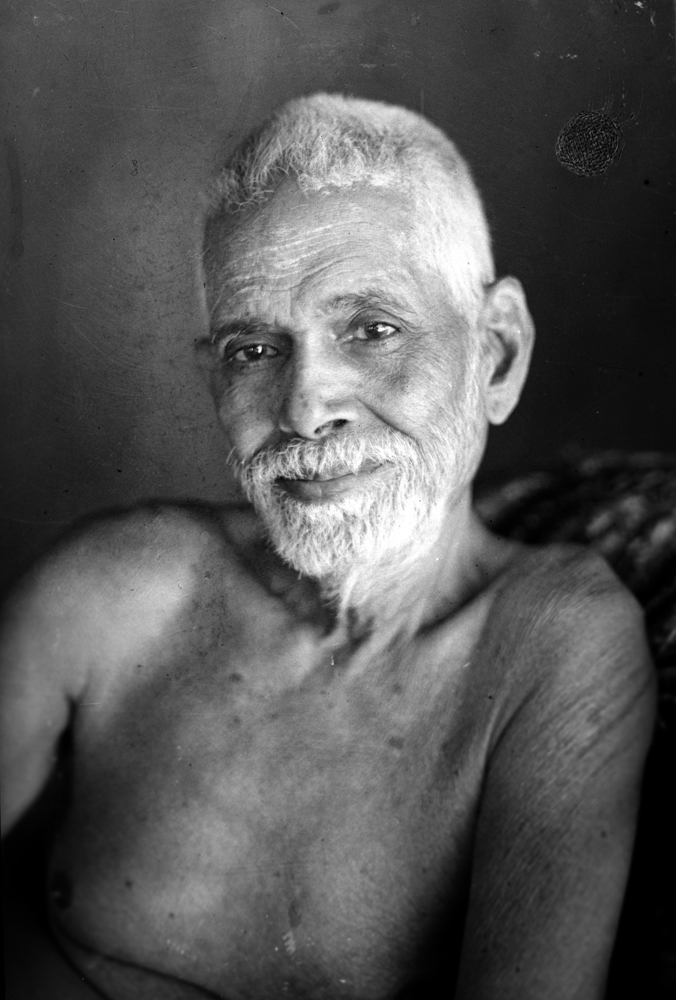
He left home shortly after, traveled to the holy mountain Arunachala in Tiruvannamalai, and remained there for the rest of his life — over fifty years. For the first years he sat in near-total silence. Gradually seekers found him, and he began teaching through a method of devastating simplicity.
The Teaching: Self-Inquiry (Atma Vichara)
Ramana’s central — and nearly only — teaching method was the question: “Who am I?”
Not as a philosophical puzzle to be answered conceptually, but as a practice of turning attention back to its source. Every thought, sensation, and experience arises to an “I” — but what is this “I”? When you trace it back, what you find is not a person, not a body, not a mind, but pure awareness itself — the same awareness described in god-as-pure-awareness.
The method:
- A thought arises
- Ask: “To whom does this thought arise?”
- Answer: “To me — to the ‘I’”
- Ask: “Who am I?”
- The “I”-thought dissolves back into its source — pure, objectless awareness
- Rest there
Key Teachings
The Self is Always Already Present
“The Self is always realized. It is not that you have to realize it. There is nothing new to get. You have only to get rid of your habit of identifying yourself with the non-self.” Liberation is not an achievement but a recognition of what was never lost.
The World and God
“God, Guru, and Self are the same.” The three are not different realities but the same awareness seen from different angles. When the separate “I” dissolves, what remains is simultaneously Self, God, and Teacher.
Sahaja Samadhi — Natural Abiding
Not a trance state but the natural, effortless abiding as awareness in the midst of ordinary activity. The eyes are open, the body functions, the person interacts — but the identification with the limited self has permanently fallen away. This parallels the Hermetic regeneration — an interior event, not a withdrawal from life.
The Convergence with Western Traditions
Ramana arrived at conclusions remarkably parallel to the Hermetic and Gnostic insights through a completely independent path:
| Ramana Maharshi | hermeticism |
|---|---|
| ”Who am I?” → pure awareness | ”The man of mind, let him recognise himself” |
| Atman = Brahman | The human mind is of the same substance as divine Mind |
| The world is not apart from the Self | The world is a “second God,” sustained by Mind |
| Ignorance (avidya) is the root problem | Ignorance of God is the greatest evil |
| Self-realization, not external salvation | Self-knowledge as liberation |
Key Quotes
“Your own Self-realization is the greatest service you can render the world.”
“Silence is the most potent form of work. The Sages did their work in silence.”
“The mind is only a bundle of thoughts. The thoughts have their root in the I-thought. Whoever investigates the True ‘I’ enjoys the stillness of bliss.”
“There is no greater mystery than this: being Reality ourselves, we seek to gain Reality.”
Connections
- advaita-vedanta — the tradition he embodies
- god-as-pure-awareness — awareness as the divine nature
- self-knowledge-as-god-knowledge — self-inquiry as the path to God-knowledge
- the-divine-self — the mirror revelation as a Maharshi-style recognition
- non-dual-recognition — the epistemological framework
- maya — the apparent world as appearance within awareness
- meister-eckhart — the Western parallel: “the eye through which I see God…”
- hermeticism — independent convergence on identical conclusions
- heaven-as-return-to-source — videhamukti, liberation at death