Meister Eckhart
The Figure
Johannes Eckhart von Hochheim — Dominican friar, theologian, and the most radical mystic in the Christian tradition. Born in Thuringia (modern Germany), he held the prestigious chair of theology at the University of Paris (twice), served as Provincial of the Dominican Order in Saxonia, and preached in the vernacular to ordinary laypeople — delivering some of the most philosophically explosive sermons in Western history.
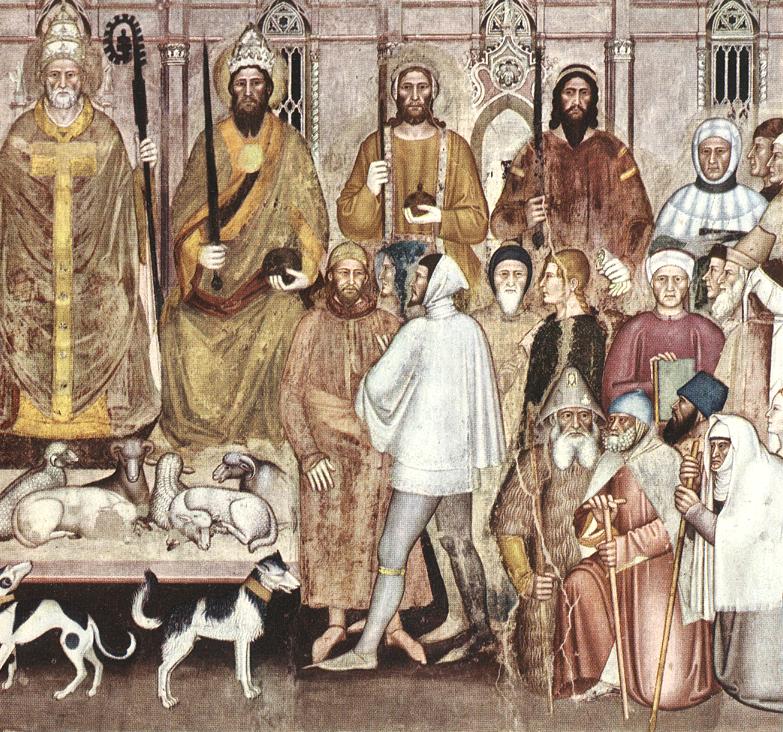
In 1329, shortly after his death, Pope John XXII condemned 28 of his propositions as heretical or suspect. Eckhart had submitted to the judgment of the Church but died before the bull was issued. His work was suppressed for centuries before being rediscovered and recognized as one of the deepest wells of non-dual thought in the Western tradition.
Core Teachings
The Ground of God and the Ground of the Soul Are One
Eckhart’s most radical claim: at the deepest level, there is no distinction between the human soul and the divine nature. “The eye through which I see God is the same eye through which God sees me; my eye and God’s eye are one eye, one seeing, one knowing, one love.” This is not metaphor — it is an ontological claim about identity. See: god-as-pure-awareness, self-knowledge-as-god-knowledge.
Gelassenheit — Releasement
The path to the divine ground is Gelassenheit — letting go, releasing, detachment from all images, concepts, and desires, including the desire for God. “If I had a God I could understand, I would no longer consider him God.” The divine is encountered precisely where conceptual grasping ceases.
The Birth of the Word in the Soul
God is continuously giving birth to the Son (the Logos) in the ground of the soul. This is not a historical event (Bethlehem) but an eternal process happening now, in every soul that becomes still enough to receive it. “What good is it to me if Mary gave birth to the Son of God fourteen hundred years ago and I do not also give birth to the Son of God in my time and in my culture?”
Detachment Above All Virtues
For Eckhart, detachment (Abegescheidenheit) surpasses even love and humility. Not cold indifference but the radical openness that comes from releasing all attachment to particulars — including attachment to spiritual experiences. The truly detached soul is “unmoved by anything that happens.”
The Parallel with Eastern Traditions
Eckhart’s thought converges remarkably with:
- advaita-vedanta — Atman = Brahman parallels the soul-ground = God-ground identity
- the-divine-self — the mirror revelation as a moment of Eckhartian breakthrough
- hermeticism — “the man of mind, let him recognise himself” echoes Eckhart’s ground-theology
- Buddhist sunyata (emptiness) — Eckhart’s “desert of the Godhead” beyond all attributes
D.T. Suzuki, the great interpreter of Zen, said: “If I understand Meister Eckhart correctly, he is the one Western mystic whose thought comes closest to the experience of satori.”
Why He Was Condemned
His propositions pushed beyond what institutional Christianity could absorb:
- “All things are nothing in themselves”
- “God is not good. I am good” (meaning: goodness is a human category too limited for the Godhead)
- “The just person is one with God” — not merely close to, but identical with
These claims dissolve the ontological gap between Creator and creature that Christian orthodoxy requires. See: non-dual-recognition.
Key Quotes
“The eye through which I see God is the same eye through which God sees me; my eye and God’s eye are one eye, one seeing, one knowing, one love.”
“God is not found in the soul by adding anything, but by a process of subtraction.”
“If the only prayer you ever say in your entire life is ‘thank you,’ it will be enough.”
“The seed of God is in us. If it was cultivated by a good, wise, and industrious laborer, it would thrive all the more and grow up to God, whose seed it is, and the fruit would be equal to the nature of God.”
Connections
- god-as-pure-awareness — the eye that sees God is God seeing itself
- self-knowledge-as-god-knowledge — the ground of the soul as the ground of God
- the-divine-self — the mirror revelation echoes Eckhart’s breakthrough
- non-dual-recognition — Eckhart as the Western non-dual tradition
- angelus-silesius — his spiritual heir in German mysticism
- plotinus — the Neoplatonic foundations of Eckhart’s thought
- advaita-vedanta — the Eastern parallel tradition
- logos — the eternal birth of the Word in the soul
- regeneration — interior rebirth as Eckhart’s central theme