Paul of Tarsus
The Figure
Saul of Tarsus, later Paul — Pharisee, Roman citizen, persecutor of the early Jesus movement, and then its most influential theologian after a dramatic conversion experience on the road to Damascus. His letters (c. 49-62 CE) form the earliest written documents in the New Testament, predating the Gospels by decades.
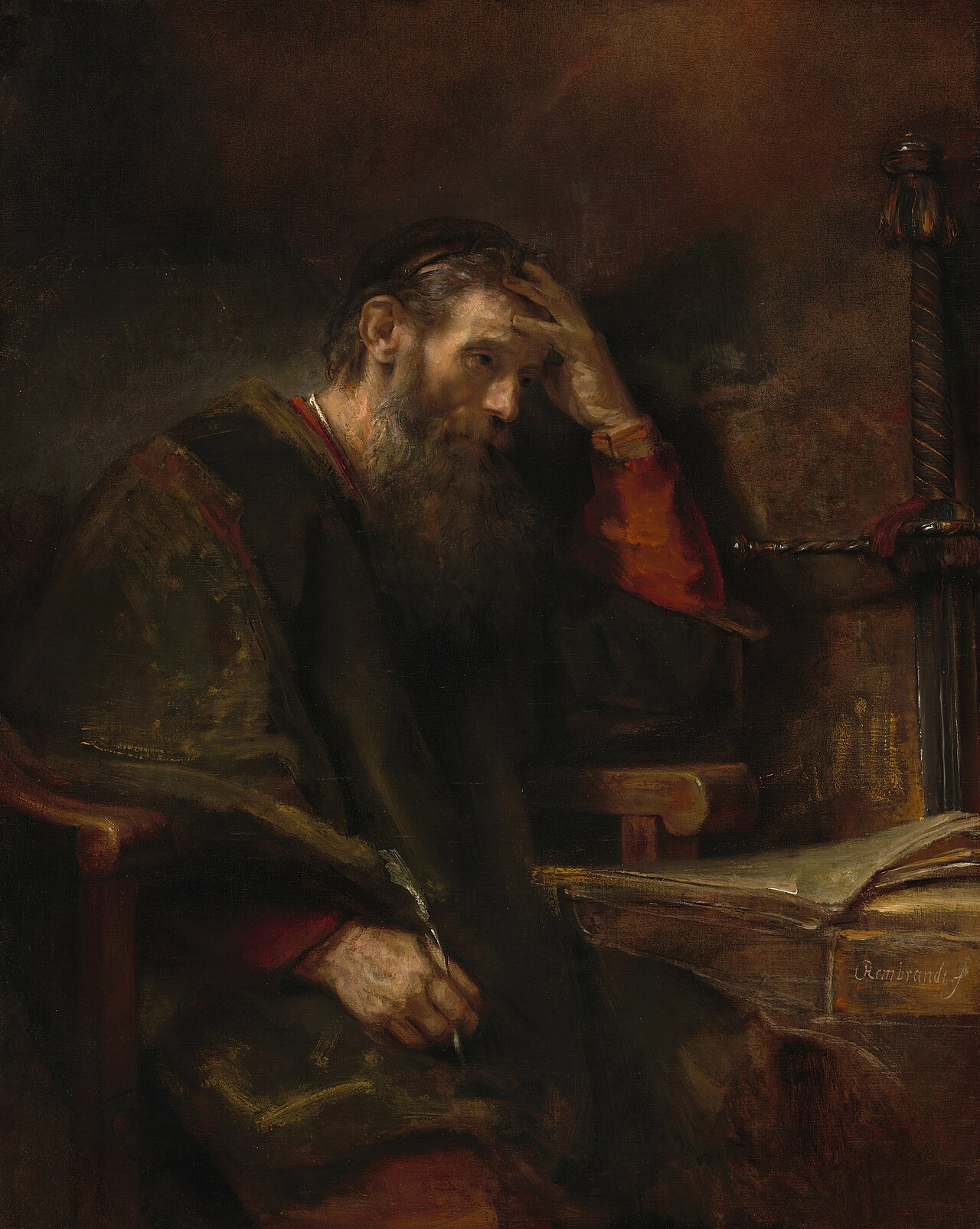
Paul matters for this exploration not as a doctrinal authority but as a psychologist of transformation. His letters contain some of the most honest descriptions of inner conflict, shadow, and spiritual metamorphosis in Western literature.
The Damascus Experience
Paul’s conversion is one of history’s most famous examples of sudden non-dual-recognition occurring through crisis rather than contemplation. A man utterly certain of his righteousness is struck blind, hears a voice saying “I am Jesus, whom you are persecuting” — and the implication is shattering: the thing you are destroying is yourself. The persecutor and the persecuted are one.
This maps onto the mirror principle described in outer-world-as-mirror: what Paul hated and attacked in the early Christians was something unacknowledged in himself.
Romans 7 — The Shadow Unveiled
Paul’s most psychologically penetrating passage:
“The good that I would do, I do not; and the evil that I would not, that I do.” (Romans 7:19)
This is a precise description of the unconscious shadow in operation — centuries before Jung gave it a name. Paul is describing the experience of a divided will, where conscious intention and unconscious compulsion pull in opposite directions. The “law of sin in my members” is not a theological abstraction — it is the lived reality of unintegrated shadow material driving behavior against the person’s conscious values.
Transformation, Not Willpower
Paul’s solution is not moral effort but transformation at the level of identity: “Be renewed in the spirit of your mind” (Ephesians 4:23). “It is no longer I who live, but Christ who lives in me” (Galatians 2:20). This is not self-improvement but self-replacement — the false self (the ego constructed around separation) gives way to something that was always already present.
Read through the lens of the-divine-self, Paul’s “Christ in me” is remarkably close to the Hermetic recognition that one’s own awareness is divine awareness operating through a particular filter.
The Mystical Paul
Paul’s letters contain passages that are unmistakably mystical and align with the non-dual traditions explored throughout this vault:
- “In him we live and move and have our being” (Acts 17:28, quoting the Greek poet Epimenides) — the universe exists within God, not alongside God. See: god-as-pure-awareness, the-dream-analogy.
- “For now we see through a glass, darkly; but then face to face” (1 Corinthians 13:12) — the veil metaphor. See: the-veil-of-forgetting.
- “I knew a man in Christ who was caught up to the third heaven” (2 Corinthians 12:2) — a direct report of mystical experience, described in the third person out of humility.
Connections
- shadow-integration — Romans 7 as the earliest Western shadow psychology
- outer-world-as-mirror — the Damascus conversion as mirror recognition
- non-dual-recognition — “Christ in me” as non-dual identity shift
- the-divine-self — Paul’s “Christ-consciousness” parallels the mirror revelation
- the-veil-of-forgetting — “seeing through a glass, darkly”
- god-as-pure-awareness — “in him we live and move and have our being”
- love-as-consequence-of-gnosis — 1 Corinthians 13, love as the supreme fruit
- gospel-of-thomas — the esoteric Jesus tradition Paul may have drawn from
- desert-fathers — the monastic tradition that grew from Paul’s letters
- meister-eckhart — later Christian mystic who radicalized Paul’s insights