
The Bodhisattva Ideal
The Concept
A bodhisattva is a being who, having reached the threshold of full enlightenment (nirvana), turns back to remain in the world of suffering until all beings are liberated. The bodhisattva vow is the ultimate expression of compassion as inseparable from realization — the recognition that one’s own liberation is incomplete while any being remains trapped in ignorance.
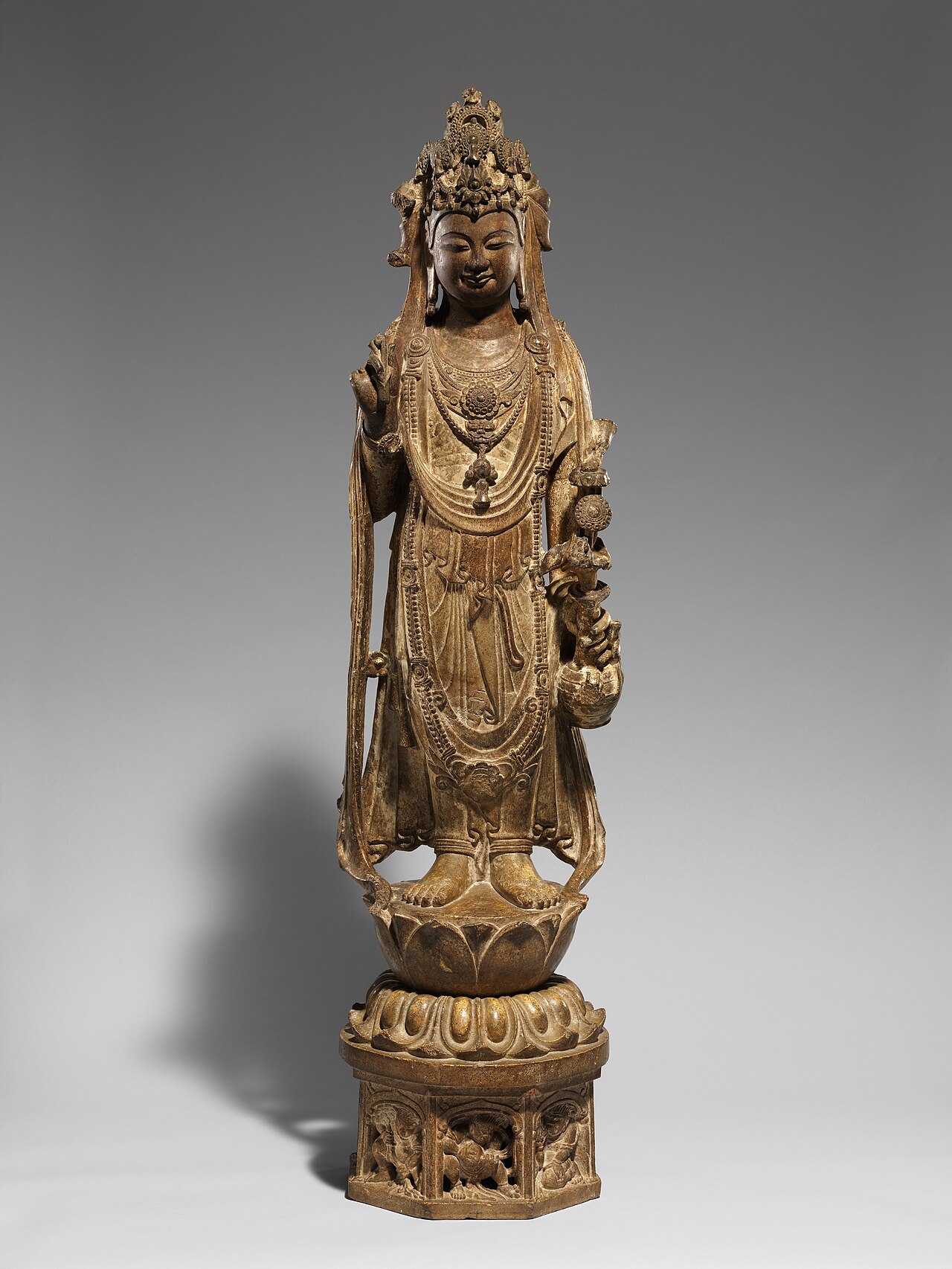
This is not self-sacrifice in the ordinary sense. It arises from non-dual-recognition: if there is no fundamental boundary between self and other, then the suffering of any being is one’s own suffering. Liberation that excludes anyone is a contradiction in terms.
The Vow
The classic formulation from the Bodhicaryavatara of Shantideva (8th century):
“For as long as space endures, and for as long as living beings remain, until then may I too abide, to dispel the misery of the world.”
This is not a temporary commitment but an open-ended one — as vast as the problem it addresses.
Why It Matters Here
The bodhisattva ideal addresses the critical question raised in dialogue-on-the-divine-self: if the outer world is sustained within God’s awareness like a dream, what is the status of other people’s suffering? Does the non-dual insight lead to cosmic indifference — “it’s all a dream, nothing matters” — or to something else?
The bodhisattva tradition answers decisively: genuine realization deepens rather than dissolves compassion. The logic is precise:
- non-dual-recognition reveals that all beings share the same awareness
- Therefore the suffering of any being is suffering within the same field of consciousness
- Therefore response to suffering is not optional charity but the natural movement of awareness recognizing itself in apparent-others
- Therefore enlightenment that ignores suffering is not yet complete enlightenment
This parallels the conclusion reached in the dialogue: “When you recognize the other as the same awareness wearing a different face, their suffering becomes as real and as urgent as your own.”
Compassion as Consequence of Gnosis
The bodhisattva ideal is the Buddhist expression of what this vault calls love-as-consequence-of-gnosis. Across traditions:
- Buddhism: the bodhisattva vow — compassion as the fruit of emptiness-realization
- Christianity: Jesus’s reduction of all law to love (Matthew 22:37-40)
- Hermeticism: the divine eros that draws everything back toward its source. See: hermeticism
- Advaita Vedanta: the jivanmukta (liberated-while-living) naturally serves, because the boundary that would make service feel like sacrifice has dissolved. See: advaita-vedanta
The convergence is striking: every tradition that reaches the non-dual summit independently arrives at compassion as its necessary ethical expression.
The Test
The bodhisattva ideal provides a practical test for the authenticity of any claimed non-dual-recognition:
- Does the realization make you more responsive to suffering, or less?
- Does it deepen engagement with the world, or provide an excuse to withdraw?
- Does it include the ugly, the broken, the difficult — or only the beautiful?
If realization produces indifference, detachment from others’ pain, or a sense that suffering “doesn’t really matter,” it is incomplete. The bodhisattva tradition insists that the final movement of awakening is always toward the world, not away from it.
Connections
- love-as-consequence-of-gnosis — compassion as the fruit of genuine realization
- non-dual-recognition — the insight from which the bodhisattva vow arises
- the-divine-self — the personal recognition that others share the same source
- shadow-integration — the bodhisattva includes darkness, not just light
- god-as-pure-awareness — all suffering occurs within the same awareness
- outer-world-as-mirror — responding to others’ suffering as one’s own
- advaita-vedanta — parallel non-dual tradition with the jivanmukta ideal
- hermeticism — divine eros as the Hermetic parallel to bodhisattva compassion
- meister-eckhart — “compassion is the highest work of the soul”
- desert-fathers — the Christian contemplative tradition with parallel ethics