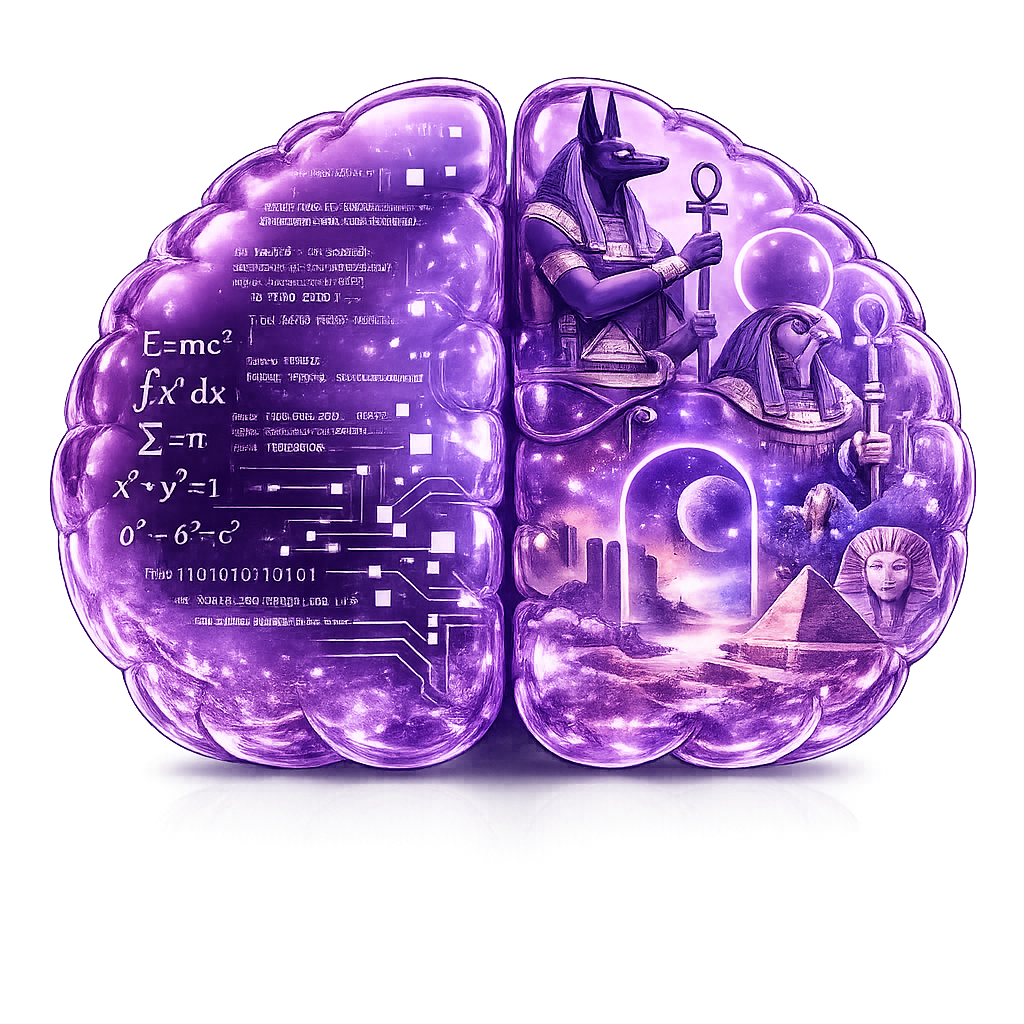
Thunder, Perfect Mind
Overview
One of the most astonishing texts in the nag-hammadi library (Codex VI) — a revelation discourse in which a divine feminine power speaks in cascading paradoxes, claiming to be every pair of opposites simultaneously. No narrative, no cosmogony, no ethical instruction — pure paradoxical self-declaration. It defies classification: not quite Gnostic, not quite Hermetic, not quite anything else. It is a voice from beyond categories.
The “Thunder” of the title likely refers to the divine voice — the theophany of God speaking. “Perfect Mind” (nous teleios) — the complete, undivided intelligence. See: nous.
The Voice
“I am the first and the last. I am the honored and the scorned. I am the whore and the holy. I am the wife and the virgin. I am the mother and the daughter.”
“I am the silence that is incomprehensible and the idea whose remembrance is frequent. I am the voice whose sound is manifold and the word whose appearance is multiple.”
“I am the utterance of my name.”
What Is Speaking?
The speaker has been identified as:
- sophia — divine Wisdom in her fullest expression
- The divine feminine principle in general — the Shekinah, Isis, Barbelo
- Consciousness itself — awareness declaring its nature through paradox
- The soul — the human psyche recognizing its own infinite nature
The most profound reading: this is god-as-pure-awareness speaking as the divine feminine — consciousness that contains and transcends all opposites. The paradoxes are not contradictions but descriptions of totality. Only that which contains all things can be both honored and scorned, first and last, known and unknown.
Why This Text Matters
Thunder, Perfect Mind performs what discursive philosophy can only describe. Where the corpus-hermeticum argues that God is beyond all categories, this text enacts that beyondness. The reader who enters into the rhythm of the paradoxes undergoes a kind of cognitive dissolution — the categories by which we organize reality begin to tremble and then collapse. What remains is something very close to non-dual-recognition.
The text also insists on the inclusiveness of the divine — the sacred encompasses the profane, the despised, the shameful. Nothing is excluded. This parallels shadow-integration: the divine does not exist only in the purified and elevated but in the rejected and scorned.
The Zen Koan Parallel
The cascading paradoxes function like Zen koans — they are designed to break the rational mind’s habit of sorting reality into neat categories. “I am knowledge and ignorance. I am shame and boldness.” The mind that tries to hold both at once must surrender its ordinary operations and arrive at something prior to categorization.
Key Passages
“Do not be ignorant of me anywhere or at any time. Be on guard.”
“I am the one who is disgraced and the great one.”
“For many are the pleasant forms that exist in numerous sins, and incontinencies, and disgraceful passions, and fleeting pleasures… until they become sober and go up to their resting place.”
Connections
- sophia — the divine feminine speaker
- god-as-pure-awareness — consciousness declaring its own paradoxical nature
- non-dual-recognition — the dissolution of categories
- shadow-integration — the divine encompassing the despised
- gnosticism — the broader tradition
- nag-hammadi — the discovery site
- nous — “Perfect Mind” as complete, undivided intelligence
- the-divine-self — recognition of the infinite within
Further Reading
- A Buddhist Bible - Goddard — contains related Mahayana texts on the nature of mind
- Corpus Hermeticum - Mead — the Hermetic sibling tradition, same era and milieu
- Thrice-Greatest Hermes Vol I - Mead — scholarly context for Gnostic-Hermetic connections