Nag Hammadi — The Discovery That Changed Everything
The Discovery
In December 1945, near the Upper Egyptian town of Nag Hammadi, a peasant farmer named Muhammad Ali al-Samman was digging for fertilizer at the base of the Jabal al-Tarif cliffs. He unearthed a sealed red earthenware jar. Inside: thirteen leather-bound papyrus codices containing fifty-two texts — the largest collection of Gnostic writings ever discovered.
The texts had been buried around 367 CE, probably by monks from the nearby Pachomian monastery of St. Palamon, following Bishop Athanasius of Alexandria’s decree that only canonical scriptures were permitted. Rather than destroy the texts, someone buried them — an act of preservation that kept them hidden for nearly 1,600 years.
Why It Matters
Before Nag Hammadi, gnosticism was known almost exclusively through the writings of its opponents — Church Fathers like Irenaeus, Hippolytus, and Epiphanius who quoted Gnostic texts only to refute them. Studying Gnosticism from heresiological sources was like studying a political party from its opposition’s attack ads.
The Nag Hammadi discovery gave the Gnostics their own voice for the first time in over a millennium. And that voice turned out to be far more philosophically sophisticated, poetically powerful, and spiritually profound than the heresiologists had allowed.
The Key Texts
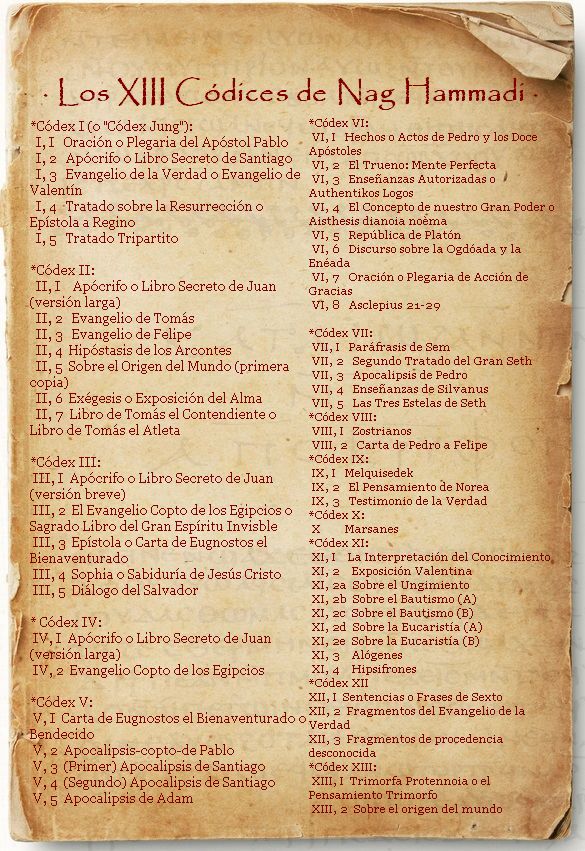
The library contains virtually every major Gnostic text referenced in this knowledge base:
Gospels and Sayings
- gospel-of-thomas (Codex II) — 114 sayings of the “living Yeshua”; possibly the earliest Jesus tradition
- gospel-of-truth (Codex I) — likely by valentinus; a contemplative meditation on ignorance and recognition
- gospel-of-philip (Codex II) — Valentinian reflections on truth, names, and the bridal chamber
Cosmological Texts
- secret-book-of-john (Codices II, III, IV) — the definitive Sethian cosmogony; found in four copies (more than any other text)
- The Reality of the Rulers — the archons’ creation of the world and humanity’s resistance
- On the Origin of the World — an alternative cosmogony
Revelation Discourses
- thunder-perfect-mind (Codex VI) — the divine feminine speaking in cascading paradoxes
- second-treatise-great-seth (Codex VII) — Christ’s first-person account of his mission
- The Three Steles of Seth — liturgical hymns for the ascent of the soul
Allegories and Treatises
- exegesis-on-the-soul (Codex II) — the soul’s fall, degradation, and restoration
- treatise-on-resurrection (Codex I) — resurrection as present spiritual reality
- The Tripartite Tractate (Codex I) — the most systematic Valentinian cosmology
Hermetic Texts
- The Discourse on the Eighth and Ninth — a Hermetic initiation text (demonstrating the close relationship between hermeticism and gnosticism in this milieu)
- Asclepius 21-29 — a Coptic translation of part of the Latin Hermetic text
The Library as a Whole
The Nag Hammadi library is not a canon — it is a collection. The texts represent multiple schools (sethian-gnosticism, valentinian-gnosticism, Hermetic, Thomasine) and span perhaps two centuries of composition. What unites them is:
- The conviction that direct, experiential knowledge (gnosis) is the path to liberation
- The sense that the human being carries a divine-spark of transcendent origin
- The diagnosis that ignorance-as-root-evil is the root cause of suffering
- The aspiration to return to the source — the pleroma, the Father, the Light
The Publication History
The texts were not published quickly. The codices passed through antiquities dealers, were held by Egyptian authorities, were stolen and recovered, and were not fully published in English until James M. Robinson’s The Nag Hammadi Library (1977). The Gnostic Bible (ed. Barnstone & Meyer, Shambhala 2003) — the edition used for this exploration — provides accessible translations with scholarly introductions.
Connections
- gnosticism — the tradition whose primary texts were preserved here
- sethian-gnosticism — the dominant tradition in the library
- valentinian-gnosticism — also well represented
- hermeticism — Hermetic texts found alongside Gnostic ones
- gospel-of-thomas — the most famous text from the discovery
- secret-book-of-john — the most copied text in the library
- gospel-of-truth — the most philosophically sophisticated
- thunder-perfect-mind — the most poetically astonishing
- song-of-the-pearl — preserved in the related Acts of Thomas
- sophia — the figure whose drama runs through most of the texts
- gnosis — the unifying concept of the entire library