Kabbalah
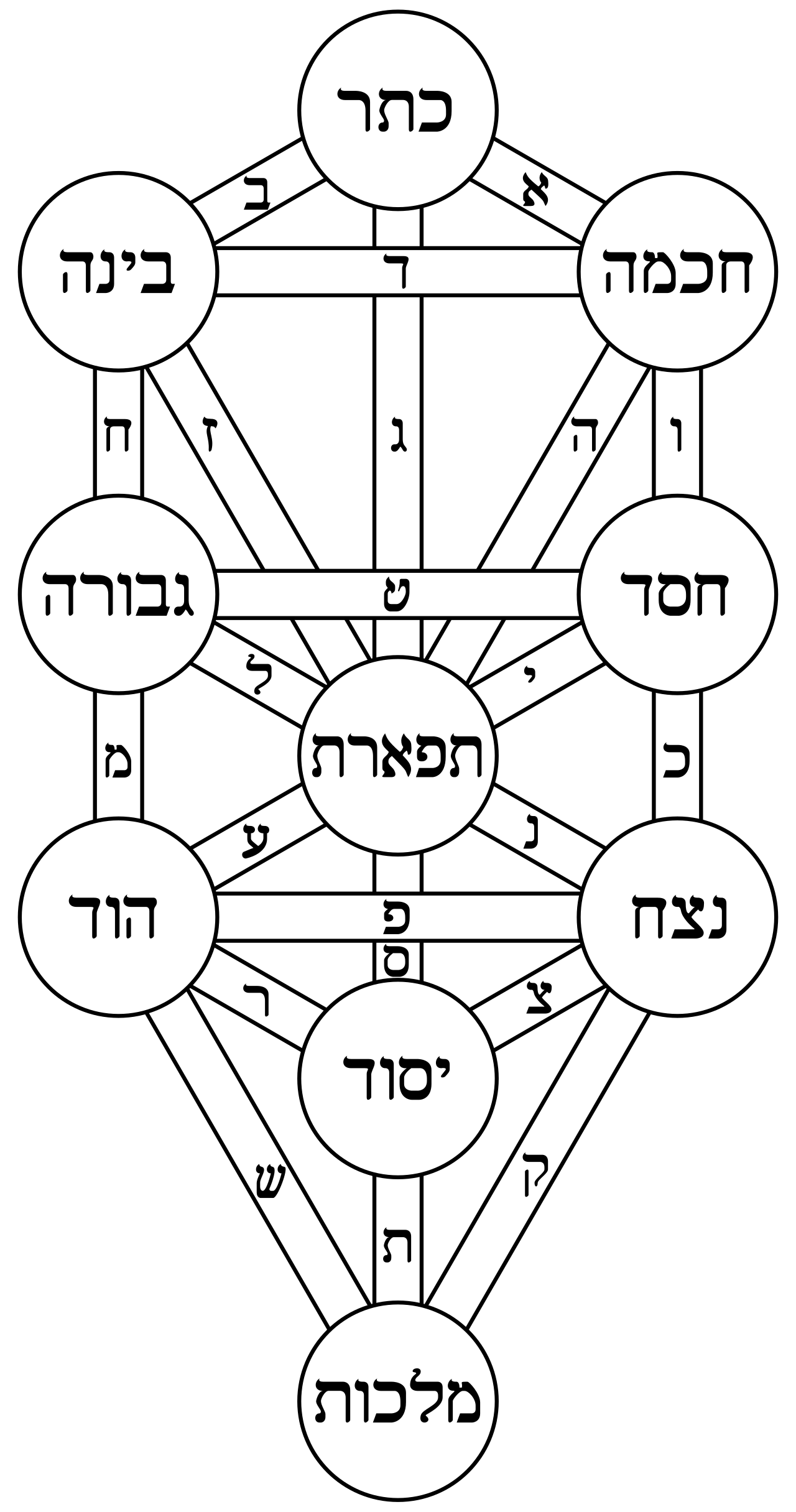
Kabbalah is the Jewish mystical tradition — a vast, layered body of thought concerned with the hidden structure of God, creation, and the human soul. At its center stands the Tree of Life (Etz Chaim), a diagram of ten Sefirot (divine attributes or emanations) through which the Infinite (Ein Sof) expresses itself in progressively more concrete forms: from Keter (Crown, the unknowable root) through Chokmah (Wisdom) and Binah (Understanding) down to Malkhut (Kingdom, the manifest world). The Sefirot are not separate gods but dynamic aspects of a single reality — channels through which divine energy flows from the unmanifest to the manifest and through which the human soul can ascend back to its source.
The Kabbalistic cosmos unfolds across four worlds (Olamot): Atzilut (Emanation), Beriah (Creation), Yetzirah (Formation), and Assiah (Action/Making). Each world contains its own Tree of Life, nested within the others like a fractal. The tradition’s central text, the Zohar (Book of Splendor), attributed to Rabbi Shimon bar Yochai but almost certainly composed in 13th-century Spain by Moses de Leon, reads the Torah as an encoded map of these divine structures. Every letter, every narrative, every commandment conceals layers of meaning about the inner life of God and the soul’s journey. The later Lurianic phase introduced tzimtzum (divine contraction), shevirat ha-kelim (the shattering of the vessels), and tikkun (repair) — a dramatic cosmological narrative of catastrophe and restoration.
Kabbalah is historically intertwined with both Hermeticism and Gnosticism in ways that scholars continue to debate. All three traditions share a cosmology of emanation, descent, and return; all three posit a divine spark within the human being; all three understand the material world as a place of exile from which the soul must find its way home. The Christian Cabala of the Renaissance (Pico della Mirandola, Reuchlin) explicitly fused Kabbalistic and Hermetic ideas, and the Hermetic Order of the Golden Dawn embedded the Tree of Life at the center of its entire magical system. Whether these parallels reflect direct historical transmission or independent discovery of the same perennial structure is one of the most fascinating open questions in the study of Western esotericism.
Key Themes
- The Sefirot — ten divine attributes forming the Tree of Life
- Ein Sof — the Infinite, the God beyond all attributes
- Four Worlds — Atzilut, Beriah, Yetzirah, Assiah as nested levels of reality
- The Zohar — the central text, reading Torah as mystical code
- Emanation and return — the divine flowing outward and the soul ascending back
- Nitzotzot (divine sparks) — fragments of holiness trapped in matter, awaiting liberation
Connections
- hermeticism — shared emanationist cosmology and the concept of ascent through spheres
- gnosticism — parallel structures of divine spark, exile, and return
- neoplatonism — the One emanating through levels of reality
- divine-spark — the Kabbalistic nitzotzot and the Gnostic pneumatic light
- pleroma — Ein Sof and the Sefirot as parallels to the Gnostic fullness
- tzimtzum — the Lurianic doctrine of divine contraction
- the-veil-of-forgetting — the soul’s descent through the four worlds as progressive forgetting
Further Reading
- Gershom Scholem, Major Trends in Jewish Mysticism — the foundational academic study
- Daniel Matt (trans.), The Zohar: Pritzker Edition — the definitive English translation
- Aryeh Kaplan, Sefer Yetzirah: The Book of Creation — early Kabbalistic cosmology
- Moshe Idel, Kabbalah: New Perspectives — revisionist scholarship challenging Scholem