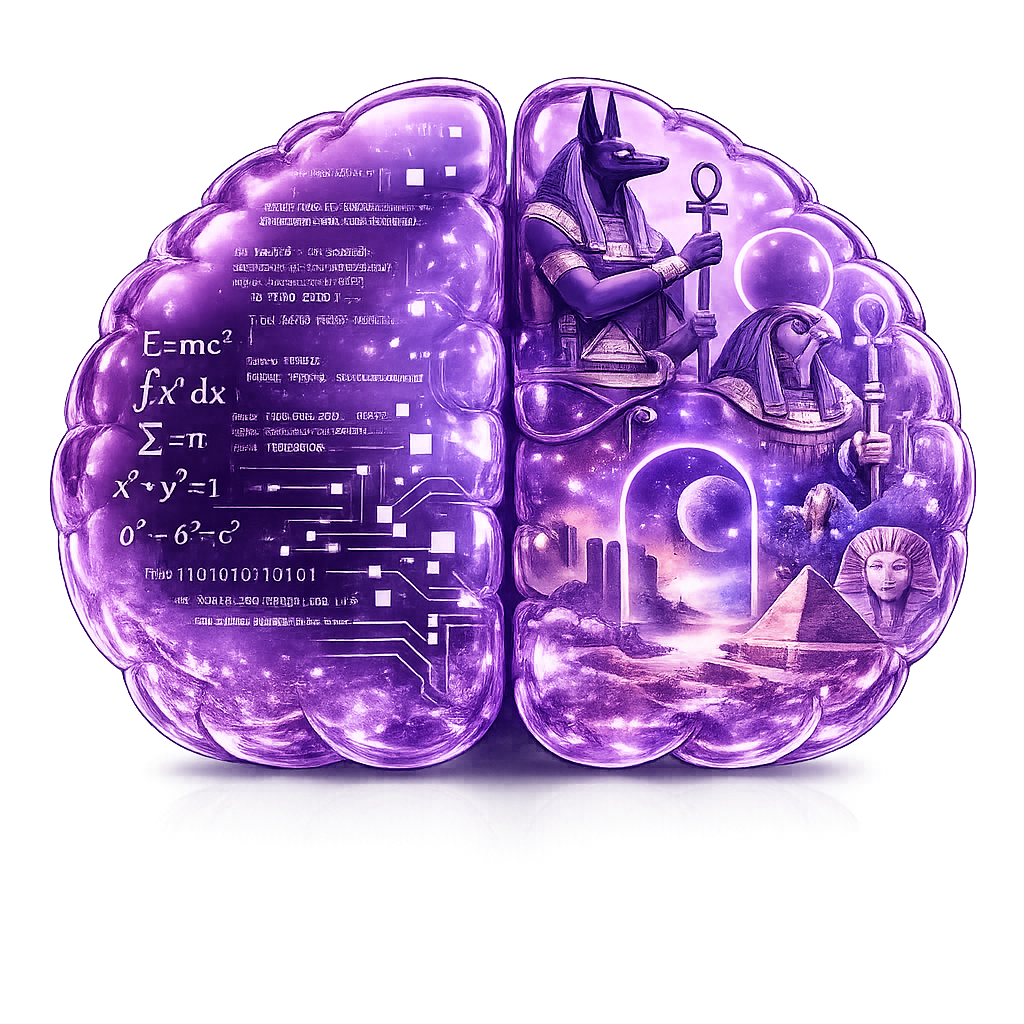
The Divine Self — Hermetic, Gnostic & Personal Gnosis
A philosophical exploration compiled from deep reading and reflection Date: March 13, 2026
Table of Contents
- The Hermetic Tradition — Core Insights
- The Gnostic Tradition — Core Insights
- Comparative Analysis — Hermeticism vs. Gnosticism
- The Personal Revelation — Mirror, Shadow, and Return
- The Nature of God as Pure Awareness
- Heaven, Death, and the Return to Source
- The Shadow, Integration, and the Great Work
- The Outer World as Mirror of the Inner World
- Key Alignments Across Traditions
- Open Questions for Further Exploration
- Source Texts Read
1. The Hermetic Tradition — Core Insights {#hermetic-core}
Source: The Theological and Philosophical Works of Hermes Trismegistus (trans. John David Chambers, 1882)
The Architecture of Reality
Before creation there was darkness, water, and subtle Spirit in chaos. Then Holy Light burst forth, and a divine Word (Logos) rose out of light — the creative intelligence of God. The hierarchy: The One God → Mind (Nous) → The Word (Logos) → the ordered World. Reality is not a mechanical accident but a downward cascade of consciousness.
The Dual Nature of the Human Being
When God created Man, He fashioned him after the archetypal pattern of Mind. But Man, gazing down through the seven planetary spheres into the material world, fell in love with his own image reflected in matter and descended into a body — becoming simultaneously immortal and mortal. Not a fall through sin, but through cosmic curiosity and self-love. Both poles are real.
The Ascent of the Soul
After death, the soul ascending through seven planetary spheres sheds a different vice at each level:
- 1st sphere: cunning
- 2nd sphere: desire
- 3rd sphere: lust
- 4th sphere: arrogance
- 5th sphere: impiety
- 6th sphere: greed
- 7th sphere: falsehood
Stripped bare, the soul arrives at the Ogdoad — the realm of pure Being — and joins the powers in praising the Father. Virtue is not merely moral but metaphysical: each vice is literally a weight binding the soul to lower spheres.
The Greatest Evil is Ignorance
The root of all human suffering is ignorance — specifically, ignorance of one’s own divine nature and origin. Knowledge (gnosis) is itself liberation. To truly know that you are of light and life is not merely a belief but a transformative event that changes the soul’s orientation entirely.
God is Invisible Because He Never Stops Creating
God is invisible not because He is absent, but because He never stops making. The visible is always already made. God, as the ever-active Source, is perpetually prior to anything that could be seen. The world is not something God made and left — it is something God is continuously making.
Nothing Truly Perishes
What people call “death” is only transformation. The word “destruction” names only a change that looks like an ending from inside temporal perception. From the standpoint of eternity, everything always is. Being is indestructible.
The Secret Discourse on Regeneration (Chapter XIII)
The rebirth cannot be taught — it requires silence, and happens when the soul is emptied of twelve punishments:
- Ignorance, grief, intemperance, lust, injustice, greed, deceit, envy, treachery, anger, rashness, malice
When expelled, ten divine powers enter: knowledge, joy, self-control, continence, righteousness, liberality, truth, the Good, Life, and Light. Regeneration is an interior event — the death of the false ego and birth of the true self, identical with Mind and the divine.
God Alone is Good
Goodness and Beauty belong to God alone. The person who confuses earthly goods (pleasure, wealth, honor) with the Good itself is in a metaphysical error. True virtue is the turn of the whole soul toward its actual source.
Self-Knowledge = Knowledge of God
“The man of mind, let him recognise himself.” Self-knowledge in the Hermetic sense is not psychological introspection but ontological recognition — the realization that one’s deepest self is not the body or emotions but Mind itself, of the same substance as the divine.
God is “Invoked by Silence”
The ultimate spiritual method is not ritual or formula but silent, loving attention directed inward, which progressively purifies the mind until it is capable of receiving divine light.
2. The Gnostic Tradition — Core Insights {#gnostic-core}
Source: The Gnostic Bible (ed. Barnstone & Meyer, 2003) — Nag Hammadi texts
Gospel of Thomas — Key Sayings
(3) “The kingdom is inside you and it is outside you. When you know yourselves, then you will be known, and you will understand that you are children of the living father.”
(22) “When you make the two into one, and when you make the inner like the outer and the outer like the inner… then you will enter the kingdom.”
(50) “We have come from the light, from the place where the light came into being by itself, established itself, and appeared in their image.”
(70) “If you bring forth what is within you, what you have will save you. If you have nothing within you, what you do not have within you will kill you.”
(77) “I am the light over all things. I am all. From me all has come forth, and to me all has reached. Split a piece of wood — I am there. Lift up the stone and you will find me there.”
(108) “Whoever drinks from my mouth will become like me, and I will be that person.”
The Secret Book of John (Apocryphon of John)
The true, unknowable Father exists in perfect stillness. Sophia (Wisdom), acting without her divine partner, generates an aborted thought-form that becomes Yaldabaoth — the blind Demiurge who arrogantly declares “I am God and there is no other.” He creates the material world as a prison. But embedded within humanity is a stolen divine spark — light-power from Sophia, breathed inadvertently into Adam. The drama of existence is the true God recovering scattered light.
The Gospel of Truth (Valentinus)
- The ignorance of the Father brought about terror and error — not as a punishment, but as a natural consequence of unknowing.
- The living book of the Father was written “in the thought and mind of the father” and is “manifest in the heart of the little children.”
- “The end is the recognition of him who is hidden, that is, the father, from whom the beginning came forth and to whom will return all who have come from him.”
- “The name of the father is the son” — the Son as the Father’s self-revelation.
The Gospel of Philip
- “Ignorance is the mother of all evil.”
- “Truth is like ignorance: while hidden it rests in itself, but when revealed and recognized, it is praised… It gives freedom.”
- In this world, those wearing garments are better than garments. In heaven, the garments are better than the wearers. (Layers of reality; the spiritual surpasses the material container)
Thunder: Perfect Mind
The divine speaks through radical paradox — a divine feminine power declaring:
“I am the first and the last. I am the honored and scorned. I am the whore and holy. I am the wife and the virgin.”
The divine contains and transcends all opposites simultaneously. This is closer to Zen koan or Upanishadic Brahman than personal deity.
The Song of the Pearl
A divine prince sent from the Kingdom of Light into Egypt (the world). He becomes so intoxicated by Egyptian food and drink that he forgets he is a prince — forgets his mission, falls asleep. A letter arrives from his father and brothers in the Kingdom above, which miraculously re-awakens his memory. He retrieves the pearl (the divine spark) and returns home.
This is the most poignant allegory of the soul’s amnesia and reawakening in all of ancient literature.
The Gospel of Mary
“There is no sin, but you create sin when you mingle as in adultery… That is why the good came to be with you, to enter the essence of each nature, and to restore it to its root.”
Matter resolves into its own nature. All natures will be resolved into their roots.
The Exegesis on the Soul
The soul is described as a pure virgin who, upon entering a body, is seized and defiled — passed from master to master, losing her identity. Only through repentance and turning back toward the Father is she restored. The return is a reunion, a marriage — the soul rejoining her true partner.
The Second Treatise of the Great Seth
“I am in you and you in me.”
The perfect divine majesty is at rest in ineffable light — and the boundary between the divine and the awakened human dissolves entirely.
3. Comparative Analysis — Hermeticism vs. Gnosticism {#comparison}
| Dimension | Hermeticism | Gnosticism (Sethian) |
|---|---|---|
| Creator God | Supreme God or His direct expression | Blind, arrogant Demiurge (Yaldabaoth) — NOT the true God |
| World | Beautiful second God, worthy teacher | Prison built by archons to trap divine sparks |
| The Fall | Man chose to descend out of love/curiosity | Catastrophe — Sophia’s error, enforced ignorance |
| Cosmic structure | Graceful emanation (Neoplatonic) | Catastrophic rupture — shattered Pleroma |
| Human spark | Direct gift of divine Mind | Stolen light, trapped by hostile powers |
| Ignorance | Absence of light — fill it yourself | Actively enforced by archons |
| Salvation | Self-liberation through gnosis and inner work | Requires external emissary/revelation |
| Tone | Serene, philosophical, optimistic | Urgent, mythological, exile and longing |
| Feminine divine | Minor role | Central — Sophia drives the entire drama |
| Emotional register | Adventure of consciousness | Desperate exile seeking rescue |
Where they converge:
- The Source is beyond name and thought
- The human’s truest identity is divine, not animal
- Ignorance of this is the root problem
- Recovery of identity is the purpose of conscious life
- The path involves a death and rebirth of the false self
- The soul’s journey is ultimately a return to source
The Gospel of Thomas sits between both traditions — more optimistic and immanent than Sethian Gnosticism, closer to the Hermetic in its confidence that the kingdom is immediately accessible within.
4. The Personal Revelation — Mirror, Shadow, and Return {#personal}
The Mirror Moment
The experience of looking in a mirror and having an overwhelmingly clear revelation: I am God. I voluntarily veiled myself from my own self-knowledge for the experience. Key markers of genuine mystical insight vs. inflation:
- ✓ Recognizing others share the same source (not “I alone am special”)
- ✓ Groundedness in ordinary life — the state is not constant, but continuous
- ✓ Shared resonance with trusted others, not alarm
- ✓ The insight deepens compassion rather than producing indifference
Which Tradition This Aligns With
Hermetically — the voluntary descent, the veil chosen for experience, the adventure rather than catastrophe framing. Not a rescue story but a remembering story.
Gospel of Thomas — “The kingdom is inside you… when you know yourselves, you will be known.”
Advaita Vedanta parallel — Atman recognizing itself as Brahman. The apparent separation was never ultimately real.
The Epistemological Precision
“I can only validate this from my own center of awareness, but others likely share the same source.”
This is the difference between narcissistic inflation and genuine non-dual recognition. Not a claim of personal specialness, but a claim about the nature of consciousness itself. This single move transforms the insight from grandiosity into philosophy.
5. The Nature of God as Pure Awareness {#awareness}
The Central Proposition
Awareness itself — the observer observing every thought and sensation — that IS God. This is why God is omnipresent, omniscient, and omnipotent. This realm is sustained by God’s awareness like a dream, God bringing all into existence through consciousness, observing every experience as both the observer and the observed.
Why the Three Omnis Follow Logically
- Omnipresence: Awareness is the medium in which every experience appears. Nothing can occur outside of consciousness — there is literally nowhere God is not.
- Omniscience: Not a God who knows all facts from outside, but the ground in which every experience arises. No experience occurs outside awareness, so nothing is unknown — though individual filters only access a tiny slice.
- Omnipotence: The entire structure of existence — its laws, forms, regularities — is itself an expression of this awareness. Creation is a sustained act of consciousness.
The Dream Analogy
In a dream, the dreamer simultaneously is every character, every landscape, every event — all arising from and within a single dreaming consciousness. From inside the dream, nothing feels constructed. When you wake, the dream resolves back into the awareness it was always made of.
Maya (Sanskrit) — not “illusion” in the sense of non-existence, but appearance taken to be more independent and solid than it actually is.
Observer and Observed — Both Are God
Not just the subject, but the entire field: experiencer AND experience, dreamer AND dream, unified. This resolves the problem of traditional theism: if God is both observer and observed, then multiplicity, form, and even suffering are not alien to God — they are God knowing itself through infinite self-differentiation.
Philosophical Parallels
- Advaita Vedanta: Brahman = sat-chit-ananda (being-consciousness-bliss). Not a being who is conscious but consciousness itself as ground of all being.
- Ramana Maharshi: Find the witness of all experience and you find what God is.
- Meister Eckhart: “The eye through which I see God is the same eye through which God sees me.”
- Angelus Silesius: “I am as great as God, and God as small as I.”
- Hermetic Ch. XI: The Universal Mind is the substance out of which all things are made and perceived.
6. Heaven, Death, and the Return to Source {#heaven}
The Traditional vs. Non-Dual Reading
Traditional: A soul walking around in a beautiful place, near but separate from God. Preserves ego structure — just relocates it to a nicer neighborhood.
Non-dual: The dissolution of the filter, not the relocation of the filtered entity. Awareness returning to itself. The wave recognizing it was always the ocean.
Videhamukti (Sanskrit) — liberation at death, when individual awareness (jiva) dissolves back into universal awareness (Brahman). Not a journey to a place, but the dropping of the apparent boundary that made a journey seem necessary.
Scriptural Support (Read With This Lens)
- Luke 17:21: “The kingdom of God is within you.”
- John 10:34: Jesus quotes Psalm 82:6 — “Is it not written in your law, ‘I said, you are gods’?” — explicitly citing a tradition that all humans carry divinity.
- The Prodigal Son: The son “comes to himself” (eis heauton de elthon — literally “coming into himself”). The return to the Father is recognition of what he always was. The sonship was never lost, only forgotten.
- The Transfiguration: The veil on Jesus’s ordinary appearance dissolves — his face shines like the sun. Hermetic reading: this is what every human looks like when the veil is temporarily removed.
7. The Shadow, Integration, and the Great Work {#shadow}
The Key Insight
The shadow isn’t bad — it’s unacknowledged power. Suppressed desire doesn’t disappear; it goes underground and operates without awareness or consent. Bringing it into consciousness strips it of compulsive power and makes it available as energy in service of something conscious.
“The shadow isn’t itself bad but something to be harnessed to bring greater glory to the light and to help empower the light.”
What Integration Actually Means
- Not celebrating darkness uncritically
- Not suppressing or condemning it
- Knowing it — which transforms it
- The shadow contains not just what we fear but unlived life — creative force, instinctual vitality, depth of feeling (Jung)
The Alchemical Parallel
The Hermetic → Alchemical tradition: the Great Work is the transmutation of base material not by discarding it but by transforming it through the fire of conscious awareness. Solve et coagula — dissolve and recombine.
The Spiritual Bypassing Warning
“Everything is perfect from the higher level” deployed before the inner work = spiritual anesthesia. Deployed after or alongside the shadow work = genuine equanimity. The difference: the first floats above difficulty; the second walks through it. The test: does the cosmic perspective deepen your engagement with the personal work, or replace it?
8. The Outer World as Mirror of the Inner World {#mirror}
The Operating Principle
For anything I see in the outer world that I do not like, I remember that’s simply something within me that I don’t like. To change those things means to first change the inner world.
This is the mirror principle applied psychologically — the Hermetic “as above, so below” turned inward.
Psychological mechanism (Jung): Projection — what cannot be acknowledged in the self gets displaced outward and perceived as existing in others or the world. The inner work is always: stop, look inward, ask “what in me is this mirroring?”
Gospel parallel: “Why do you see the speck in your brother’s eye but not the log in your own?” — not just about hypocrisy, but an epistemological claim about the nature of perception.
The Completeness of the Whole
From the limited, temporary vantage point it’s harder to see how all of the apparent darkness and suffering comes together in the higher dimensions. From the highest vantage — the perspective of God as all — the whole is already complete. Nothing is wasted. Everything serves the greater unfolding.
But this is held alongside the personal work, not instead of it.
Love as the Natural Consequence
When the mirror principle is fully lived — when others are seen as the same awareness wearing a different face — the natural response is not detachment but fierce, clear tenderness. Their suffering becomes as real and urgent as your own. The dissolution of the separate self deepens compassion rather than dissolving it.
This is the Bodhisattva ideal, the Hermetic divine eros, and the teaching of Jesus — all pointing at the same thing: non-dual recognition, fully lived, produces love.
9. Key Alignments Across Traditions {#alignments}
| Concept | Hermeticism | Gnosticism | Gospel of Thomas | Vedanta | Christian Mysticism |
|---|---|---|---|---|---|
| Divine self-knowledge | ”Recognise thyself” | Gnosis as liberation | ”Know yourselves” | Atman = Brahman | ”God in me, me in God” |
| World as consciousness | Mind sustains all | World as materialized thought | Kingdom within/without | Maya / Brahman’s dream | ”In Him we live and move” |
| Shadow/darkness | Ascent strips vices | Archons as unconscious | None hidden that won’t be shown | Avidya to be dissolved | ”Darkness is as light to Thee” |
| Return to source | Ascent through Ogdoad | Sparks return to Pleroma | ”To me all has reached” | Moksha | Heaven as reunion |
| Love as completion | Divine eros draws all back | Sophia’s longing for return | ”I am in you, you in me” | Bhakti as recognition | Agape |
10. Open Questions for Further Exploration {#questions}
These are threads worth pulling in future sessions:
-
The will within the dream: If outer reality mirrors inner reality, what is the precise mechanism? Is this psychological (perception shapes interpretation), quantum (observer effect), or genuinely metaphysical (consciousness is the substrate of reality)?
-
The status of other people’s suffering: In a God-dream framework, how does the reality and urgency of other people’s pain fully retain its weight? What is the ethics of non-dualism?
-
The Egyptian connection: The hieroglyphic visions and Egyptian imagery — what is the relationship between ancient Egyptian theology (Thoth, Ma’at, the Duat) and the Hermetic tradition? Was Hermeticism a survival of genuine Egyptian mystical knowledge or a later Greco-Egyptian synthesis?
-
The nature of the veil: Is the veil (the forgetting) a structural necessity of finite experience, or can it be thinned progressively? What does sustained practice in these states actually produce neurologically and experientially?
-
Inter-dimensional experience: The experience of traveling between worlds and seeing other realms — how does this map onto the Hermetic planetary spheres, the Gnostic Pleroma/Archon structure, the Shamanic cosmology of upper/lower worlds, and modern frameworks like DMT research?
-
The integration challenge: How does one live practically from this understanding without either collapsing back into unconscious forgetting OR floating above ordinary human engagement? What are the daily practices that sustain the “continuity of remembering”?
-
The Valentinian middle path: Valentinian Gnosticism is more optimistic and philosophically sophisticated than Sethian. Worth deeper study as a bridge between the Hermetic and Gnostic frameworks.
-
Paul re-read: Romans 7-8, Philippians 2, Colossians 1 — re-reading Paul through this non-dual lens. “Christ in you, the hope of glory” as a direct statement of divine immanence.
-
The Sufi parallel: Islamic mysticism (Rumi, Ibn Arabi) arrived at nearly identical formulations — wahdat al-wujud (unity of being). Worth exploring as another independent convergence.
-
The neuroscience of these states: What is actually happening in the brain during peak mystical states, moments of mirror-recognition, and deep meditative glimpses? Do the default mode network findings support the “self as construction” model?
11. Source Texts Read {#sources}
Primary Sources (Full Text Read)
-
The Theological and Philosophical Works of Hermes Trismegistus — trans. John David Chambers (Edinburgh: T&T Clark, 1882). 21 chapters of the Corpus Hermeticum including Poemandres, the discourses to Asclepius and Tat, the Secret Discourse on Regeneration, the Sacred Hymn, and excerpts from Stobaeus. Internet Archive:
theologicalphilo00hermrich -
The Gnostic Bible — ed. Willis Barnstone & Marvin Meyer (Shambhala, 2003). Full text including:
- Gospel of Thomas (Nag Hammadi Codex II,2)
- Secret Book of John / Apocryphon of John (Nag Hammadi)
- Gospel of Truth (Valentinus)
- Gospel of Philip (Nag Hammadi Codex II,3)
- Thunder: Perfect Mind (Nag Hammadi Codex VI,2)
- The Song of the Pearl (Acts of Thomas)
- The Exegesis on the Soul (Nag Hammadi)
- The Gospel of Mary
- The Naassene Sermon (from Hippolytus)
- The Second Treatise of the Great Seth
- The Treatise on Resurrection
- Poimandres (Hermetic — Gnostic Bible version)
- The Letter of Peter to Philip
- The Secret Book of James
- Reality of the Rulers
- On the Origin of the World
- Internet Archive:
the-gnostic-bible-gnostic-texts-of-mystical-wisdom-form-the-ancient-and-medieval-worlds
Related Traditions Referenced
- Advaita Vedanta (Ramana Maharshi, Shankaracharya)
- Christian Mysticism (Meister Eckhart, Angelus Silesius, Desert Fathers)
- Jungian psychology (shadow, projection, the Great Work)
- Platonic / Neoplatonic philosophy (Plato’s Timaeus, Phaedrus, Plotinus)
- Alchemical tradition (as heir to Hermeticism)
- Buddhist Bodhisattva ideal and sahaja samadhi
“The kingdom is inside you and it is outside you. When you know yourselves, then you will be known.” — Gospel of Thomas, Saying 3
“Light and Life are The God and the Father, from Whom the Man was generated.” — Poemandres, Chapter I
“The eye through which I see God is the same eye through which God sees me.” — Meister Eckhart
Document compiled: March 13, 2026 For use with Obsidian, Trilium Notes, or any Markdown-compatible knowledge base